Saturday, November 15, 2014

32nd Saturday in Ordinary Time

Lk 18:1-11

In 1969 The Doors released an album titled, “The Soft Parade.”  Critics do not list it among one of their better albums but, for better or for worse, it was part of the soundtrack for my later years at Penn State and beyond.  It is the only Doors album in my collection (I preferred The Moody Blues).  It was a concept album in which the title track was placed last rather than the first on the disc.  That title track, The Soft Parade,  began with Jim Morrison proclaiming “when I was back there in seminary school there was a person who put forth the proposition that you can petition the Lord with prayer.” 

He repeated, “petition the Lord with prayer" twice more with increasing sarcasm in his voice.  And then screamed
“YOU CANNOT
PETITION
THE LORD
WITH
PRAYERRRRR.”  

By then the drugs had completely addled his brain. He would be dead less than two years later, most likely of a heroin overdose.  He was wrong.  

You can petition the Lord with prayer. 
You should petition the Lord with prayer. 
You must petition the Lord with prayer. 

The gospel illustrates how to petition the Lord with prayer.  One word comes to mind.  Importune.  To importune means: to demand with urgency or persistence; to annoy, to beset with solicitations; to be troublesomely persistent.  A three year-old’s entire job is to importune.  And three year-olds importune very well indeed. 

Only the first of the definitions for importune fits when one is considering prayer:  to demand with urgency and persistence.  One can never annoy or trouble God with prayer.  What one would think is too much is barely enough.   The entire psalter, from Psalm 1 to Psalm 150, is a long, continuous, importuning prayer.  It is a model for how we are to pray.   

The widow in the Gospel would not give up.  No matter what the unjust judge did she returned importuning until he gave her a just judgment.  The judge’s motivations for giving that judgment were less than pure; fear of being struck rather than a desire for justice, motivated his ruling.  Today in Massachusetts the fear would be not being reelected to his or her sinecure.  The judge's actions recall T.S. Eliot’s observation, “The final temptation is the greatest treason, to do the right thing for the wrong reason.”  But God can never be unjust.  Jesus asks the rhetorical question: “Will not God then secure the rights of his chosen ones who call out to him day and night?”  In the context of this Gospel passage we know the answer.    
_____________________________________________________________
Given that the roots of this homily played out in Geary Hall (Chris' and my room) and Tenner Hall (Paul and Al's room) at Penn State,  (Paul brought the album to Penn State at the start of sophomore year) it seems appropriate to include a few shots from the side-trip to Penn State after retreat.  I didn't take as many shots as I thought I would. The skies were very gray and I was tired.  However, I did stop a few times along Rt. 45 on the way down.  Rt. 45 is my favorite road.  Were I to know I had to give up my driver's license I would hope I could take one more drive from Plymouth to Penn State and back along 45.  Then I would be ready.  

Rt 45 is two lanes all the way from just outside of Danville to Boalsburg.  It then breaks at 322 and, after a bit of a dog leg continues west toward Pittsburgh.  I've never traveled that part of it.  One of my favorite places is driving through Mifflinburg and Hartleton.  Hartleton is the location of one of the most infamous speed traps in PA.  It is a real hazard driving to football games.  The limit drops from 55 to 35.  As soon as I see the sign for Hartleton I slow down.  Yes, I got a speeding ticket driving through there many years ago.  Beginning with Mifflinburg and extending west until the state game lands, there are many Amish farms lining the roadways.  And many buggies. 


Whenever possible I pull off at Hairy John State Park, a bit further down 45.  If I ever get another speeding ticket on 45 it will be on the mountainous state game roads.  There is a picnic area in Hairy John that is very popular with people heading to the game early.  The first photo is a road that gradually goes up the side of the mountain.  The other is a detail of a picnic table in the pavilion.  That photo is an interesting survey of texture in natural objects.


I took the first shot of Old Main from the top of the Pugh Street parking garage.  Wonder why I never thought of going up there before?  Will do so again on my next trip. The second photo is from ground level. 


The Rathskellar, universally known as "the Skellar," is on the corner of Pugh St. and College Ave.  I haven't been in there in decades but was a regular once I hit 21.  It is below ground.  If there was ever a fire it would be a catastrophe.  But, the beer is cold and plentiful.  A custom during my time there was that upon turning 21 a student would go to the Skellar to order "a box of rocks" i.e. a case of pony bottles of Rolling Rock beer from nearby Latrobe.  The idea was to drink it all.  I did some foolish things at Penn State involving alcohol but nothing quite that foolish. And, I turned 21 during break.  By the time we returned the glow was off the event of turning 21.  But it was a rush being able to go there in the first place.  Finally. Watched most away football games there. 

Walked through Whitmore Lab.  The second door on the right (open) is where I had organic chemistry lab fall term sophomore year.  The aroma in the building hasn't changed.  There are rumors that it is going to be torn down.  That would be a pity.  The second photo is an architectural detail, the kind of which will never been seen again on a campus anywhere. 


In the homily I quoted Eliot.  Thus the photo of the outdoor pool near the Natatorium.  During my last year at PSU my niece Kate came up for a football game with her parents.  It was Penn State-Pitt, last game of the season.  It was cold.  As we walked back to my apartment downtown we passed the pool which, at the time, was brand new.  A guy was standing on the top platform ready to jump into the water.  I suspect  that first, he was drunk and second, he really didn't want to go through with it but the crowd that had gathered was getting impatient.  So he jumped and received great applause.  My 12 year-old niece was beyond impressed.  She decided then and there that she wanted to attend Penn State.  And she graduated with her degree in microbiology eleven years later in 1982.   

+Fr. Jack, SJ, MD

Wednesday, November 12, 2014

Back From Retreat

32nd Wednesday in Ordinary Time 
Lk 17:11-19

Leprosy appears regularly in both the Old and New Testaments, particularly the Old.  Leprosy as understood in the Ancient Near East  had, and has, nothing to do with leprosy as known in more modern times, a disease now called Hansen's Disease.  Indeed, there is no good evidence that Hansen's disease existed during Jesus' time in the area where he lived.  In scripture, leprosy was not necessarily a disfiguring physical illness due to nerve destruction.  It was a vaguely defined non-specific group of skin conditions and blemishes that resulted in the bearer of the lesion being cast from society.  Even clothing or the walls of a home could be declared to have leprosy. Today we would call it mold.   

The Gospel highlights the interdependence of faith and thanksgiving. Only one of the ten lepers healed by Jesus in Luke's narrative returned to express his gratitude when he realized that he had been healed.  The response of those healed, the response, or lack of response, of those who could now return to normal society, is the main point of the narrative. The gospel highlights the unfortunate disconnect between faith and thanksgiving that characterizes too many Catholics today.

Obviously the ten lepers had some degree of faith in Jesus.  Otherwise, they would not have yelled to him from a distance, pleading to be cleansed, nor would they have set out to present themselves to the priests simply because he told them to do so.  But only one, a foreigner, returned to give thanks, upon realizing he had been cleansed.

The story recalls the saying that there are no atheists in foxholes.  Alas, many of those who get out of the foxhole alive resume their atheist ways.  We saw a similar phenomenon after 9/11.  Churches were packed in the aftermath.  Briefly.  And then shopping, the childrens' sports competitions, and other forms of diversion resumed their place of primacy thus improving the parking at most churches but keeping the mall humming. 

Faith cannot exist, it cannot grow or persist without prayer.  Faith cannot be maintained without thanksgiving.  Faith depends on prayer.  Prayer is not just for petition.  It is not, or should not even be, primarily for petition.  Prayer is praise.  Prayer is thanksgiving. Prayer expresses gratitude to God for what He has done, for what He is doing, and for what He will do for us, even if we don't understand it at the moment. 
___________________________________________
Long hiatus.  I was on retreat at the Abbey of Regina Laudis in Bethlehem, CT from 27 October to 4 November.  Regina Laudis is a cloistered monastery of forty Benedictine nuns.  Their age ranges from the mid-20's to post-80's.  Mother Dolores Hart entered in 1963.  She is the subject of an academy award nominated documentary "God is Bigger than Elvis."  She gave Elvis his first screen kiss.  Her films include "Where the Boys Are" and "Come Fly with Me" where she starred with Dean Martin.  She told me it was her favorite movie.  A very gracious woman. 

After the retreat I drove to Plymouth, made a quick trip to State College to see Al and Karen, and then went to D.C. for a baptism on Sunday.  Got back here Tuesday, fifteen days after leaving.  Except for the time in D.C. I had little access to internet.  Another two-week sojourn, non-retreat, is coming in February, more details later.

It was a good retreat with some important discernment.  Lots of light, a helping of shadow, and much rest.  I celebrated Mass daily  for eight days.  The difference was that the Mass was novus ordo and chanted in Latin using classical Gregorian notation.  Found out that I could actually write a homily longhand and read it, if I was careful.  

I took many photos while there.  The Abbey is on 400 acres of forested land.  Quite a bit of it is outside the enclosure and thus accessible.  The church is on top of a hill and not attached to the monastery.  Interesting arrangements but after seeing the church I can understand it.  Am posting quite a few photos. 

The original monastery for the tiny group of nuns who began it in the late-1940's.  It is now the men's guest house.  The first floor corner in the foreground was the two-room chaplain's quarters.  Rustic but comfortable.

In the rustic theme I was doing some inside photography trying to capture of Dutch genre painting feel.  These things were on the shelf.  It was simply a matter of tilting the brass vase. 

The grounds are lovely.  Autumn leaves were coming to an end but some were falling into a nearby pond. 

The view from the back of the Monastic Church. 

The Church taken from the choir lost.  The nun's choir is behind the grille.  At communion the door in the middle is opened and they approach the opening to receive. 


The door opening for communion. 

The crucifix on the altar.

The nuns during vespers one evening.  I took the photo through a glass door so that the shutter wouldn't disturb the sisters hence the glare. 

The three postulants approaching the altar at the end of vespers.  The woman in the middle entered the novitiate on 1 November in a very moving ceremony when she was clothed with the habit and white veil. 

The chapel in the lower monastery.  This was, I assume the original church.  It is used for some of the hours during the day, compline at night, and for Mass either when the road leading to the church on the hill is inaccessible or, as was the case on All Soul's Day, there is a special Mass for the sisters.  The curtain at the lower half of the grille is pulled back during the hours. 

The Benedictine motto is Ora et Labora (Prayer and Work).  The sister below is wearing the work habit.  You see the ear protector.  You do not see the chain saw she was using to cut trees.  The Abbey has a farm, a small dairy herd whose milk is used to make (excellent) cheese, and sheep.  They grow much of their produce. 

An old barn on the property.

A sun-catcher in an old shed, first from the outside and then from the inside. 


+Fr. Jack, SJ, MD

Wednesday, October 22, 2014

Field Trip

Three men are making the thirty-day Spiritual Exercises at the Campion Retreat Center.  Monday was their second break day.  During the retreat there is a break day around day 10 and another around day 20.  The break is not rigidly set at days 10 and 20.  In Australia one of the break days was changed in favor of better weather two days hence.  The men wanted to visit St. Joseph Abbey (Trappist) in Spencer.  The director could not take them and asked if I could.  With pleasure.  The two Carmelites were most interested in seeing the Trappist Preserves operation.  They make small batches of jams and jellies at their monastery in TX.  

After lunch at a place with good pub grub near the monastery we perused the gift shop and spent some time in prayer in the church awaiting the 3:00 PM meeting at the guest house.  One of the men who is a friend of mine took us to Trappist Preserves at 3:00.  As I simply buy the stuff and have little interest in how it is made I wandered throughout with the camera.  Then as a treat we wound up in the Holy Rood Guild where the vestments are made.  Spencer-made vestments are instantly recognizable and exquisitely made. They are also made with impeccable taste.  In general there are no pictures of saints, no mottos or anything else.  Most especially they are nothing at all like the dreadful vestment that has faux-tapestry of the children of the world all over it  There are few vestments I refuse to wear but that is one of them.  By the time it was all over I'd taken over 200 photos.  

The leaves were at peak color at the monastery.  Given the wind and rain that is falling at the moment I suspect they will all be down by the weekend.  However, one can't complain because we have had a splendid autumn.  Rather than posting a homily today I want to post photos and some explanation.  Lots of photos.

Details of a Celtic Cross in front of the gift shop at the entrance to the Abbey.

 The  bell tower of the monastic church taken from a hallway.

The second is "the cottage" where men who are testing their vocation to the abbey spend time until it is felt they are ready to stay in the monastery itself for an observership.  I made last year's vow retreat in the cottage, indeed in the room that is pictured.  It is the only self-contained room with its own entrance thus I didn't distract the other men who were there. 

The foliage in front of the cottage was brilliant, as it was last year when I made my retreat at the end of September. 

There was ivy climbing on the pink wall of one of the buildings.

 The road leads about a mile before it ends at the boundaries of the enclosure.  There is another road in the other direction about the same distance.  The abbey sits on 2000 acres of beautiful rolling land. 

The Trappist Preserve plant is highly mechanized.  The monastery, founded in Rhode Island, was moved to MA in the 1950's.  The original plan was to make a foundation in MA but the monastery in RI burned and thus everything moved to Spencer.  


The storage area fascinated me.  One of the monks wondered why I was taking a photo of an ugly green and very large storage area.  Answer:  Because it looks great in black and white as a study in angles and geometry. 

The prior (second after the abbott) gave the men the tour.  He is the one in the white robe and black scapular.

The boxes are filled automatically.  The preserves are made in small batches and are delicious.  The best is the Red Pepper Jelly that is hard to find in markets but is easy at the gift shop.  I go to Spencer monthly so I rarely run out.  There is nothing like peanut butter on a Ritz cracker with a dollop of red pepper jelly first thing int he AM to help "the medicine go down, the medicine go down, the medicine go down. . . . in a most delightful way."


These are some of the preserves.  The ginger preserve is also amazing (along with mango pepper, cranberry pepper, and the usual flavors).

The Holy Rood Guild showroom where the vestments are displayed and sold is like Nordstrom's or Sak's for Catholic priests.  The colors and textures of the fabrics were the reason for the photos.  The first is a watered silk chasuble that is on display.  They don't make anything of watered silk these days. 

I took the next three because of the color and texture.  Sometimes photography needs an abstract or at least a non-figurative approach.  


As we were leaving the cloud cover arrived allowing this photo of the sun's rays. 

And here we have the happy group at the end of a good day. 

+Fr. Jack, SJ, MD

Sunday, October 5, 2014

27th Sunday in Ordinary Time

Is 5:1-7
Ps 80
Phil 4:6-9
Mt 21:33-43

Today’s gospel begins where last Sunday’s ended.  The first reading and the Gospel illustrate the dependence of the New Testament upon the Old Testament.  They remind us that Jesus came not to abolish the Old Covenant  but to fulfill it.  The images that Jesus used in the parable, the vineyard, the wine press, and the tower came directly from Isaiah. They make the same painful point about fidelity to God’s law.  But Jesus moved beyond Isaiah. 

Cultivating a vineyard is an extremely complicated and difficult undertaking. 
During tertianship, the last formal training a Jesuit does before he is called to final vows, our twelve-man tertian class made the thirty-day retreat at the Sevenhill Jesuit Retreat House on the grounds of the Jesuit winery just outside of Clare, South Australia.  The Clare Valley, with 35 wineries, is one of the centers of the Australian wine industry.  Sevenhill, established 135 years ago, was the first of the wineries.  It sits on 1000 acres rolling hills covered with grape vines.  The setting is beyond beautiful.  But, the beauty obscures an important fact, caring for a vineyard is difficult ,demanding, and at times, thankless work.  Sometimes, despite precautions, backbreaking work, the commitment of the wine master and the  dedication of the workers, the harvest is not good and the wines are less than wonderful. 

Unfortunately, 2011 was a catastrophic year in the Clare Valley.  It was unusually cold and cloudy. There was way too much rain during the critical harvest period.  In the end only sixty percent of the grapes were harvested.  The others died on the vine.  But, the winemakers at Sevenhill and the rest of the Valley did not give up.   At out place, Brother John and his staff continued to nurture the vines, nourish the soil, and do whatever else was necessary for the following year's harvest.  So it is with God who loves us and forgives sin.

In the first reading we heard the vineyard owner’s dismay when, despite constructing the vineyard, putting in a watchtower to prevent sabotage, and carefully cultivating the grapes, he harvested not sweet grapes but useless sour wild grapes. 

Isaiah was, like Jesus in the gospel, using the image of the vineyard for the people of Israel, people who, despite God’s care for them, worshipped false idols, ignored the law, and became like sour wild grapes that could not be used for fine wine.  But there is hope.  There is hope of reestablishing the loving relationship between God and His people.

The psalm plays off Isaiah’s images.  Once again the vineyard is a symbol for the people.  The psalmist asks the Lord to restore the vineyard, to resume caring for it, despite the poor harvest, despite the people abandoning the covenant yet again.  If He does this they will no longer withdraw from Him.  There is a combination of confession, faith, and bargaining going on in the psalm.  But the psalmist, who captured the essence of human behavior in this psalm, knows that God is forgiving and will relent. 

Jesus takes the vineyard image further than Isaiah.  He predicts his death.  But he also tells of the mission to the Gentiles, those who were not part of the original covenant.  “The stone that the builders rejected has become the cornerstone.”  Truer words have never been uttered.

There are three more verses at the end of this parable.  The last two are critical to put the parable’s effect, and of all of Jesus’ teaching in context.  “When the chief priests and the Pharisees heard his parables, they knew that he was speaking about them.  And although they were attempting to arrest him, they feared the crowds for they regarded him as a prophet.”  The truth hurts.  Sometimes the truth hurts the one who states it.  Killing the bearer of the truth may be much easier than making fundamental changes in our lives and actions as a result of being told that truth.

Five more chapters of parables and discourses  follow chapter 21 before Matthew recounts Jesus’ passion and death.  They are worth reading at home.  All of them are familiar.  All of them challenge us, just as they challenged Jesus’ hearers.  At times they are painful because we see ourselves in them. It is not a pretty picture.  We can clean up that picture easily enough. The instructions are in the second reading:  Do “what you have learned and received and heard and seen in me. Then the God of peace will be with you.”  That peace will surpass all understanding.  That peace will trump anything we can imagine.  
________________________________________________________________

Yesterday, was perhaps one of the most mind-blowing days for those who love Division I College Football.  Penn State was not playing nor was Boston College.  However, the upsets, the 'last plays' and everything else came together for one of the most fun days of football watching in a long time.  Even when a buddy stopped in unexpectedly and we decided to grab a pizza, the fun was merely interrupted not ended.  The end of the USC-Arizona State game may have pushed "The Pass" (Doug Flutie to Gerald Phalen) out of advertising.  Alas, the next few Saturdays are going to be very busy and football watching will be at a minimum.  Then comes my 8-day retreat.  At a monastery.  No football.

Below are some of the photos from Chad.  I didn't take many during the month there.  I was forbidden from being seen in public with the camera.  Thus the shots I took were limited to the hospital, school, the grounds, and other private settings.  Did get a few from the roof of the medical school.  I wanted to get some more but the friend who took me up to the roof came down with malaria.  Asking him to walk up five flights did not seem like a good idea.  Next year perhaps.  

Doing an EKG in class at the medical school.  I haven't seen the sucker cups in years.  There was nothing worse in medical school than having to apply these to a man's chest if it was hairy.  Even on smooth skin they didn't always adhere well despite the goop.  

The front entrance of the medical school. 

Carlos, a Jesuit MD, teaching.  He was using a tree branch as a pointer.  A few minutes after this I remembered the laser pointer with slide advancer in my briefcase.  With a total lack of tact and class I got up, walked to the front of the room, took the twig and gave him the pointer.  "Use this."  He did.  It is still there.  

The view from the medical school across the street.  The people are not walking on the wall though it appears that way.  The hospital complex grounds were below the grade of the road.  Drivers had to go slowly pulling into the hospital because of the dip. 

A statue of the Bon Samaritain (Good Samaritan) on the hospital grounds.

Teaching how to take blood pressure.  

+Fr. Jack, SJ, MD

Sunday, September 28, 2014

26th Sunday in Ordinary Time

Ez 18:25-28
Ps 25
Phil 2:1-11
Mt 21:28-32

In August 2011 I was in Saigon, Vietnam.  The high point of ten days there was a visit to the Jesuit novitiate where I spent over an hour with the 29 novices.  After about twenty minutes speaking to them about the nature of tertianship, the long retreat, and a few other topics relevant to Jesuit novices, I threw things open to questions. The first question was a challenge: “Father, of the three vows: poverty, chastity, and obedience, which is the most difficult?”  I looked at my questioner, sighed and said, “Some days, all three of them” and went on to dissect each vow before stating that, of the three vows, obedience is the most difficult, a feeling shared by many religious of other orders. Obedience was the most important of the three vows for St. Ignatius of Loyola, the founder of the Society of Jesus.  It was the vow on which he expended the most energy in the section of the constitutions dealing with the vows.  Obedience is a prominent theme in today’s readings

The second half of the first reading is familiar from the Liturgy of the Hours.   “Though he was in the form of God, Jesus did not regard equality with God something to be grasped at . . . .He humbled himself, becoming obedient to the point of death, even death on a cross.”  Jesus’ obedience to the Father’s will was perfect obedience.  It was an obedience that we humans are, for the most part, incapable of attaining, though that is not an excuse for not trying.  Obedience is the point of today's Gospel reading.

These verses appear late in Matthew’s Gospel just after Jesus’ triumphant entry into Jerusalem.  In the days between that entry, paved with palm branches and hosannas, and the arduous journey carrying the cross, Jesus engaged in a number of debates and discussions with the chief priests and elders. These debates helped to seal His death warrant.  He was cutting too close to the bone for the authorities to bear.  There is a reason for the saying, “the truth hurts.”  Sometimes it hurts the one who tells it.  Through the use of parables Jesus pointed out the contradictions between what the priests and elders preached and how they lived.  He demonstrated how they heard John’s call to repentance but failed to heed it.  He pointed out their fundamental disobedience to God’s will.

The second son, the one who said he would go to work in the vineyard but did not go, represents those who proclaimed the law but failed to follow through on its principles and demands. They are the hypocrites. They are the actors who play a role they do not believe in.  Many of them are now officials in all levels of government from small municipalities to the highest national levels, the very highest.

The first son, who initially refused to work in the vineyard but then obeyed the father’s request, represents the social and religious outcasts of the time, the sinners, who, despite not following the law in the beginning, heard John's call to repentance and eventually heeded it.  They are like those of us who, after many attempts, finally quit smoking, or get sober, or stop gossiping about our neighbors, or resist taking Christ’s name in vain, or . . . fill in the blank.  It took them time.  But, they eventually heard the message of obedience to the will of God. They heard message to repent for their sins and acted on it.

How often have we acted like the second brother?  How often have we promised to do something and then reneged on that promise?  How often have we made a commitment and then not honored it?  How often have we said we will avoid sin, and then happily went about committing the same ones?  How often have we acted like the first brother who refused the request but who, perhaps as the result of a guilty conscience, quietly went and did what we were originally asked to do? 

The most likely answer to both questions is often.  We can all accuse ourselves of mouthing principles that we fail to practice, the “do as I say not as I do” syndrome.  However, we can all take comfort in the fact that sometimes, after an initial misstep or series of missteps, we get it right and follow God’s will for us. 

We heard in the responsorial psalms,
“Good and upright is the Lord;
thus he shows sinners the way.” 

We need only heed the message, and follow the way.

We also heard,
“The sins of my youth and my frailties,
remember not;
in your kindness remember me,
because of your goodness.” 

Even when we have acted like the second son in the parable, when we have been hypocritical or disobedient, it is not too late.  We heard the promise in the first reading that, if anyone turns from wickedness and does what is right and just, his life shall be preserved, he shall live and not die.

Truly the Lord is good and upright.
_______________________________________________________________
The first photo is of the 29 Vietnamese novices.  Their questions were also to the point and a real challenge. 

Detail of a baptismal chapel gate in a 12th century church in Lyon

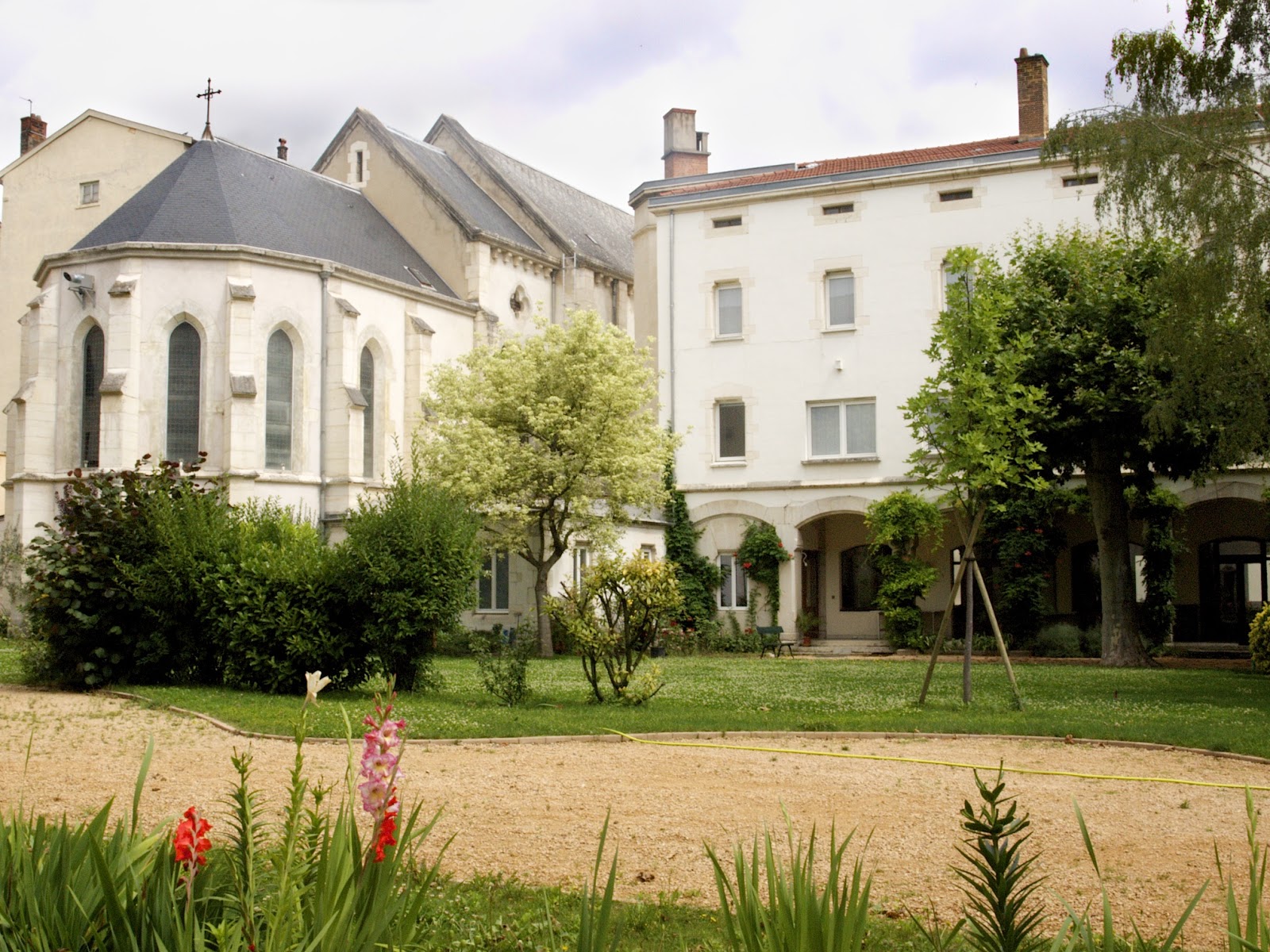
The gladiola has never been a particular favorite, probably because it seems invariable in funeral bouquets.  I had a standing order with the florist in Plymouth when I ordered flowers, "No Gladiolas."  But, they are rather attractive in their natural setting.  These were in the cloister garth of the community in Lyon, a community in an old Visitation monastery.  


 +Fr. Jack, SJ, MD