Friday, July 20, 2018

More Photos

The kiddos arrive for the week of English camp on Sunday.   Today is Friday.  Sleep remains problematic at night.  Is time to think a bit of Ambien tonight.  Went out with camera at 5:30 AM after waking at 3:00 following a few fitful periods of sleep.   Sv. Višarje is insanely beautiful and even more insanely steep.  The paths are either cobblestone or gravel.  

The Carthusian motto came to mind as soon as I approached this cross which appears to be on the highest peak behind the church.  Stat crux dum volvitur orbis or The Cross is Steady While the World Turns. 

Looking east at sunrise.  It was not a far walk to the top but very steep.  Took my time to be sure.

The bell tower of the church from above.

A close up of the bell tower and the sundial.  It appears accurate around 6 AM.

The retaining wall along the steps leading from the rectory to the church.  The wall is at least ten feet tall at the foot of the steps.  Flowers are growing out of the crevices the entire height and length.  

A stained glass window of Esther with the play of light on a kind of altar to the Sacred Heart.  The light drew me as soon as I saw it. 

The tabernacle on the altar. 

The celebrant and concelebrant chairs.  Concelebrated a tri-lingual Mass this AM.  None of the languages was English but I managed to give the concelebrant's prayer in Slovenian.

From the sanctuary looking toward the entrance on the left.  First of the many pilgrims/tourists who came up when the gondola opened at 9 AM.

The Latin inscription reads: In this place the mother of Christ stood.

An intriguing arrangement. 

Posted this in both color and black and white.  Shooting through the window grates into the church.  Everything was a little high so I had to use the articulating screen on the back of the camera rather than the viewfinder.  Very pleased with the result. 

+Fr. Jack, SJ, MD

Wednesday, July 18, 2018

Photos, photos, and photos

Arrived in Ljubljana yesterday.  It feels as if I never left.  Did the dishes after lunch, concelebrated Mass, and wandered the streets though jet lag limited this last activity.  By 9:00 PM is was a hurting cowboy.  In bed at 10 and up at 3:30 (nap pending).  Went out with camera at 5 AM for a couple of hours.  In town less than twenty-four hours and two long photos sessions.  

Weather is good.  Tomorrow, Thursday 19 July, I head to the mountains in Italy just across the border.  Will keep up with documenting the photos.  No homilies for the next two weeks as I don't expect to preach, certainly not in Slovenian.  

This first set is from last night.

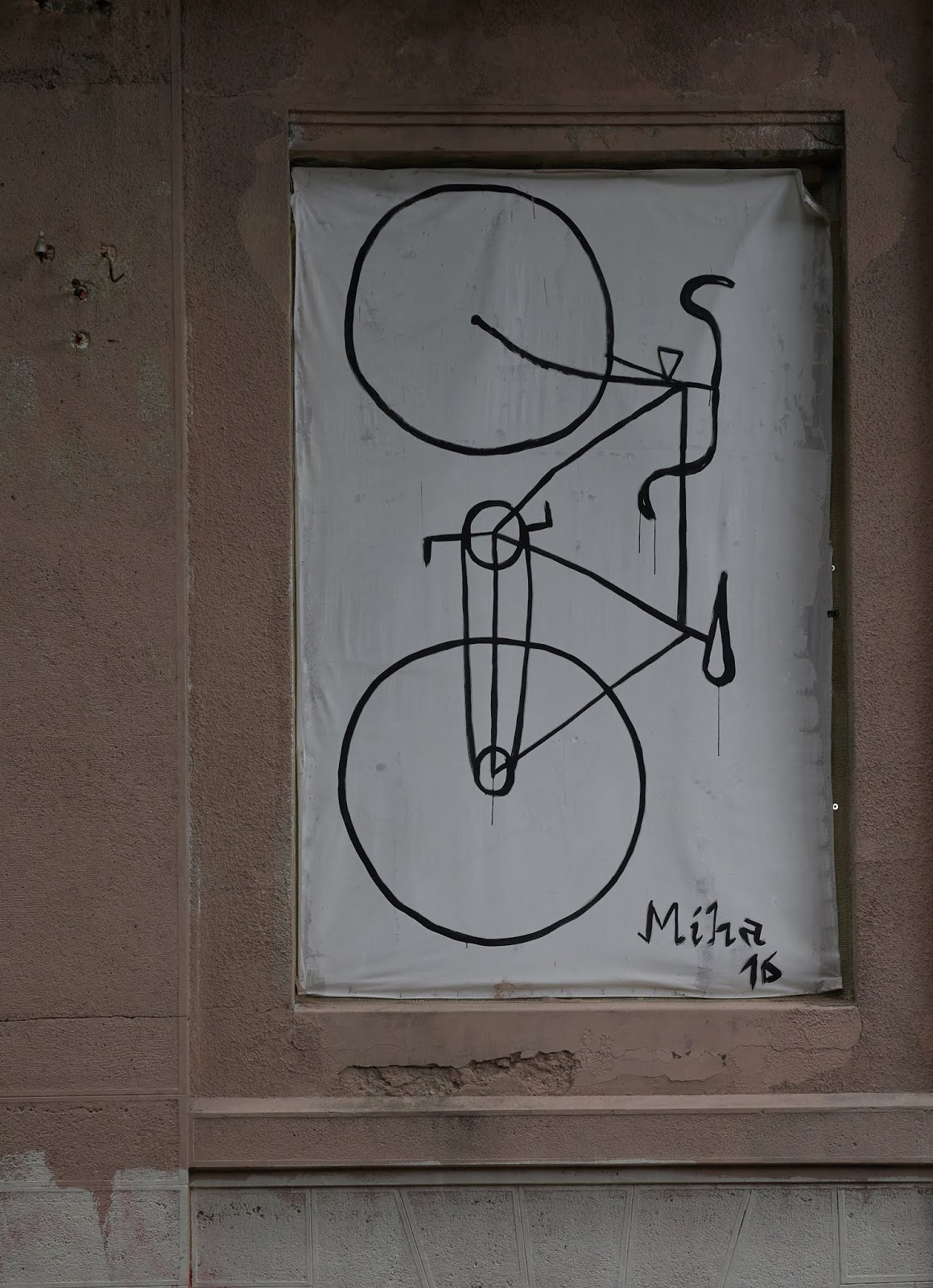
The bicycle graphic was hanging in the window of a factory overlooking the Ljubljanica river.  

A tourist checking his cell phone.  The center of town is crawling with them.  Every outdoor cafe/bar was jammed.  I am grateful that I had the opportunity to explore the city on cold winter nights when I had it to myself.  
 The spires of the cathedral at sunset.

Stumbled across this jazz quartet.  They were very good.  


Some shots demand black and white.  This was one of them. 

Gelato anyone?

The lover's locks on the Butcher's Bridge

Patterns and repetition are intriguing.  These are a number of stalls, now idle, at the central outdoor market.

Reflection and duplication of the cathedral's dome and spires in a window about one hundred yards away.

Young couple sitting as bus drives by. 

This next set came from a walk at 5 AM.  Already processed a number of them.  

A chair turned on its side as a man gets his place ready.

Chandeliers are fascinating.

The cafe was not yet open but getting ready.  There are tourists all over town.  Last night this place was booming.

Sunrise and the cathedral.

Setting up at the outdoor market.  Setting up and taking down every day has got to be backbreaking and tedious work. 


Open window at a bar along the river.

Walking to work at 6:00 AM.

Wine display and a selfie.  Shooting shape, light, color, and texture is one of my favorite types of photography.

Laundry overlooking the river.  An American condo association would frown on this big time. 

A frosted glass graphic at a bar. 
'It is good to be "home."  Alas, it is only for two weeks but I intend to make the best of it. 

+Fr. Jack, SJ, MD

Saturday, July 14, 2018

Memorial of St. Kateri Tekakwitha

Memorial St. Kateri Tekakwitha  

Kateri Tekakwitha was born in 1656 in what is now Auriesville, New York near the Canadian border.  She was orphaned at four when her parents, a Catholic Algonquin mother and a Mohawk chief father, died of smallpox.  Her brother also died.  She survived the infection but was left with severe facial scars and partial blindness.  Taken in by an aunt and uncle she received her first knowledge of the Catholic faith from the Blackrobes, the name by which Jesuit missionaries were known.  She was baptized at eighteen.  Her uncle, who replaced his brother as chief, allowed her baptism under the condition that she remain in the village.  He was not sympathetic to Catholicism.  Indeed, he detested the Blackrobes, but had to tolerate their presence under a treaty laid down by the French.  Two years after her baptism she fled her village for St. Francis Xavier Mission two hundred miles away.  She traveled on foot. 

She was by all accounts devout, attending Mass twice daily, fasting, ministering, to the sick, praying, teaching the faith to children. She pronounced a vow of perpetual virginity on the Feast of the Annunciation in 1679.  Shortly afterwards her health began to deteriorate. She died of tuberculosis in 1680 just before turning twenty-four.  She was beatified in 1980 and canonized in 2013.

Many of the saints whose memorials we celebrate throughout the liturgical year were well-known during their lives.  Some wielded considerable power. Consider Benedict of Nursia and Ignatius of Loyola, both of whom are celebrated in July.  Today, by way of contrast, we celebrate the memorial of a saint who was insignificant during her lifetime.  It was three hundred years before she was beatified.  She was poor, scarred, partially blind, and uneducated.  It is unlikely she could have understood the writings of Benedict, or Ignatius, or Bonaventure--whose memorial would be tomorrow were it not a Sunday--even if she could read.  

Yet, her life is a greater example for us than the lives of the heavy hitters.  Her life is an example because of, its simplicity and ordinariness, not despite that simplicity. Like Théreèse of Lisieux she lived her own "Little Way."  A quote attributed to her illustrates the depth of her faith, her fearlessness, and her embrace of a life in imitation of Jesus, poor, chaste, and obedient. 

“I am not my own; I have given myself to Jesus. 
He must be my only love. 
The state of helpless poverty 
that may befall me if I do not marry does not frighten me. 
All I need is a little food and a few pieces of clothing. 
With the work of my hands I shall always earn what is necessary
and what is left over I’ll give to my relatives and to the poor. 
If I should become sick and unable to work, 
then I shall be like the Lord on the cross. 
He will have mercy on me and help me, 
I am sure."

If only we could all hold Saint Kateri's certainty and live with her attitude of simplicity.

__________________________________________________________
The photos here were taken in Gloucester, MA at the Jesuit retreat house in late November 2011, a few years before the rebuilding.  My favorite kind of photography captures and transmits a mood, a sense of place, rather than being simply a snapshot to record the details of something.  I never, ever, ever take "selfies" (a truly ugly word) and rarely photograph people unless they are incidental to the scene.  This excludes, of course, requests to photograph an event.  No, I will never ever ever do a wedding.

This was an old falling down, or at least tremendously unkempt, shed.  The moment I saw this scene the name Andrew Wyeth came screaming into my brain.  Fortunately I took a number of shots.  A year later the shed had been cleaned, repaired, screening (ugh) put on the window.  It was now a meditation chapel for the retreat house.  More useful but less photogenic. 


Another shot of the interior of the shed.  

This photo was driven by the contrast in shape, color, and texture of the various components.  I love black and white photography. While the first two here would work just as well in black and white this one must be in color. 

Am heading to Slovenia on Monday evening.  Will spend one week in LJ and another at Mt. Lussari (Sveti Višarje in Slovenian) at a summer camp for those who are trying to learn English.  The campers, mostly teenage, will come from three countries. They will have no common language except English.  I will be the only native English speaker. 

+Fr. Jack, SJ, MD

Sunday, July 8, 2018

14th Sunday of Ordinary Time


Ez 2:2-5
Ps 123:1-4
2 Cor 12:7-10
Mk 6:1-6

What was the thorn in Paul's flesh?  The second reading raises many questions but supplies no answers. What was the nagging irritation that kept Paul from being too elated?  What bothered him so much that he likened it to being beaten by an evil spirit?  Don't bother looking it up.  There is no agreement among scholars from Augustine to the present. 

Some suggest it was any of a number of physical ailments, including, eye disease, recurrent kidney stones, or attacks of biliary colic. While possible, purely physical diagnoses are not probable.  St. John Chrysostom wonders if the thorn was the unrelenting criticism by opponents who complicated his struggle to preach the gospel.  Paul's acceptance of weaknesses, insults, and persecutions would support such an argument. Other commentators suggest temptation.  Was it temptation to power?  Temptation to pride?  Was it lust? Was the thorn all of the above, some of the above, or something else entirely?  Perhaps the thorn was the burden of realizing that he was a sinner, his awareness of the human condition, from which he suffered in the same way we do today.  Paul may have been burdened by an awareness of his sinful self.  Perhaps it was the guilt he experienced when he recalled his complicity in the persecution of Jesus' followers or the memory of his silent assent to and support of Stephen's martyrdom.

How often do we cringe at a memory?  How often do we wish we could forget how we hurt another?  How often do we want to take back words that we said, or pain that we caused, when we realize that we acted wrongly?  How often do we regret acting on our prejudices without thinking first?  That question leads us to the gospel.  

The Gospel is fascinating.  It exposes one of the most satisfying and self-destructive of all sins: smugness.  Smugness is defined as self-righteous complacency.  Smugness would lead many of us to gaze over the crowd and assume that had I been present at this scene I never would have criticized Jesus for being a local kid come back years later.  I would never have felt that Jesus was the boy from down the street who is so full of himself.  

In reality the odds are very high that had any of us been standing with the crowd we would have said or felt the same things they did.  We would have joined in the chorus of disapproval; “Just who does he think he is?” “Where did that son of a carpenter get all of this?” 

While it doesn’t matter whether or not we nurture fantasies of standing apart from the crowd in this gospel story, complacent self-righteousness that is uninformed by facts, can devastate our relationships in community, at work, in family life, and just about everywhere else.  At times we must be skeptical, but that skepticism must be supported by fact rather than feelings or old memories.

It is a challenge to honor the “prophets” in our midst, the prophets in our families, the prophets about whom we think "I remember him when . . . " "I remember when she was . . ."  It is a challenge to accept the success-story of the guy with whom we went to junior high school.

Smugness is destructive pride.  It is prejudicial in the extreme.  It causes us to exert premature closure on something we may need to hear. It may cause us to reject the truth out of hand simply because we know the messenger and don't particularly like him. "I wouldn't trust a word that came out of his mouth" is a sad commentary about the speaker.  That was the sin of Jesus’ critics.  They knew everything about him—or so they thought.

In his commentary on this passage, the late Jesuit Father Dan Harrington described the crowd’s attitude as the “prejudice of familiarity.”  The prejudice of familiarity is a particular risk for those of us who live in a religious community because we know each other well.  At times it is true that familiarity breeds contempt.  It is a risk in our families, our schools, and work in general. “Where did he get all of this?” “Who does she think she is?"

These are not reactions peculiar to the villagers of 1stcentury Palestine.  To paraphrase Walt Kelly's most famous Pogo cartoon: We have met the faithless and they is us. 

______________________________________________
Heat broke.  Gorgeous weather this weekend.  Off to celebrate Mass at St. Patrick in about two hours.  

The first photo is that of a memorial bench in front of Bapst Library on the BC campus.  The quote is worth pondering. 


This flag is sitting in a pewter mug, a med school graduation gift from one of my favorite high school teachers.  The effect is that of a macro lens though I was not using macro (I don't have any macro lenses and have no intention to acquire any) done by using the equivalent of 300 mm, a wide-open 2.8 lens, and manual focus.  

+Fr. Jack, SJ, MD

Wednesday, July 4, 2018

Homily for July 4

Amos 5:14-15, 21-24

July 4th.  Fireworks. Cookouts.  Parades. Ice-cold beer. And, of course, fireworks and the Pops on the Esplanade.

For over two hundred years the country has celebrated the audacious move to separate from British colonial domination.  The choice was made after much deliberation and debate.  Not all were in agreement.  For some it seemed better to remain subject to the British crown.  However, seeing the depths to which the British Royal Family has sunk, it is obvious that the Founding Fathers were either prudent or prescient. 

Where are we now? 
Where are we going?  
The answer to the latter question is a source of major anxiety.

The first reading from Amos, is fortuitous for today's holiday: "Seek good and not evil,that you may live"

If we pray for anything today, we must pray for a return to civility in American society.  We must pray for a society being ravaged by the extraordinarily foul language spewing from the mouths of harridan-like comediennes, whose lack of respect for others is damning evidence of their lack of self-respect.  

We pray for a society in which reasoned discourse and debate has been replaced by the disinhibited emotional--and frequently foul-mouthed--screeds of late-night talk show hosts and celebrities whose overall value to society is questionable.  

We pray for a society in which legislators have descended to a lowest-common-denominator--a very very low common denominator--in their public pronouncements and behaviors.  

"I spurn your feasts, says the LORD,
I take no pleasure in your solemnities;
Your cereal offerings I will not accept,
nor consider your stall-fed peace offerings.
Away with your noisy songs!"

I am not being partisan.  All critiques of incivility, hostility, outright obscenity, and the kind of temper-tantrums generally outgrown by age three, apply equally to democrats, republicans, and the splinter and special interest groups populating the spectrum around and between. The churches are not exempt. 

The concept of the common good has been sacrificed to personal desire and special interest demands.  The only difference between the demonized 1%, many of whom are our legislators, and those populating the lower ranks of society, is that those lower down on the income ladder are working within smaller budgets.

The Fourth of July has historically been a time to celebrate. However, watching the morphing of perverse sexuality into a good that must never be questioned or condemned, being forced to applaud and admire surgical and hormonal violations of natural law and physical integrity, and witnessing the domination of the culture of death, there is much to fear, there is much to mourn.
________________________________________________________________

I took this photo about four or five years ago down at Boston Harbor after disembarking from a cruise with friends.  The outsized 'T' token (the still current name for the subway) exists no longer.  It has been replaced by the Charlie Card.  Obvious reference, that.  Don't know if it is still there as I"ve not been down to the waterfront in a long time.  Should get down some day but today, 4 July, is not a time to travel through Boston even if the temp were not quite so high.  


+Fr. Jack, SJ, MD


Sunday, July 1, 2018

Homily for the 13th Sunday in Ordinary Time

Wis 1:13-15, 2:23-24
Ps 30:2,4,5,6,11-13,
2 Cor 8:7,9, 11-13
Mk 5:21-43
One of the most spectacular choruses in Handel's Messiah is a study in contrast. In the superb recording by Boston Baroque it begins with a short minor chord on the organ after which the chorus sings a cappella: "Since by man came death, since by man came death." Then the organ and orchestra explode with joy as the chorus proclaims: "By man came also the resurrection of the dead" three times. 
After a silence-filled pause the sequence is repeated. A minor chord leads into another a cappella passage: "For as in Adam all die, for as in Adam all die." That is followed by another joyful explosion as organ, orchestra and chorus proclaim: "Even so in Christ shall all be made alive" four times. This kind of contrast is apparent in today's readings. 
The first reading began with "God did not make death, nor does he rejoice in the destruction of the living." God is not a sadistic marionetteer who induces personal tragedy in random fashion. Nor is God a benign magician who guides a desperation pass into the arms of a receiver in the end-zone--not even the magnificent Flutie to Phalen pass at Miami, or, to think of it, the glorious pass with which Penn State defeated Boston College in the 2014 Pinstripe Bowl. Both ends of this continuum represent an idea of faith that is fit only for a three year-old.
God created the world for mankind. God created us in His own image to be imperishable. We promptly rejected those gifts for the hubris of being completely self-determining. Thus death entered the world. And so it remains: hubris, sin, and death. But then we see hope in today's long Gospel reading. 
It would be easy to spend most of a semester on this particular Gospel reading. Faith, death, ritual impurity, the significance of a 12 year-old girl and a 12-year flow of blood. Sociology, medicine, theology, philosophy and more, all wrapped up in one reading.
The gospel includes what is sometimes called a "Markan Sandwich." A Markan sandwich begins with a narrative that is interrupted by a different self-contained narrative followed by the conclusion of the first narrative. The themes uniting both narratives are faith and the most dire forms of ritual impurity: menstrual blood and death. 
The woman was excluded from full-participation in the land of the living by her chronic state of ritual impurity. That state was due to what today would be called dysfunctional uterine bleeding. Was it uterine cancer? Probably not. She would not have lived 12 years. Fibroids? Something else? No clue. She was not only continuously bleeding; she was also infertile. Infertility was understood as a great curse. But, because of the flow of uterine blood, merely being touched by her, intentionally or unintentionally, would transmit ritual impurity. That contagion of impurity was a very bad thing for all concerned. 
Jesus actively risked ritual impurity by touching the young girl's dead body. Of course today we are much too sophisticated to believe in ritual impurity. We are too modern to believe that contact with another individual could defile or contaminate us. Yeah, right!
Try being a smoker, banished to the margins, a portico, a store overhang, the back porch, along with being treated with disdain by a certain self-righteous tribe. Suggest that animals have their place, and it does not equal that of humans, and one may be castigated or accused--horror of horrors--of being a "speciesist," whatever that might mean. Are you against abortion? Would you rather not kill grand-pop because he is ill or simply old? Don't admit that at a cocktail party in Cambridge unless you want to be excluded from subsequent invitations. The sniffed retort would be, "I could never socialize with someone with such unenlightened views." We still believe in ritual impurity. We call it by other names, oftentimes ending with spurious designations as 'isms' 'ists' or, my all time favorite, "PHOBIA." We still believe in ritual impurity and its transmission. We still act against--or sue--those we presume to be infected with it. 
"Since by man came death, by man came also the resurrection of the dead." We heard this reiterated in the Alleluia verse: "Our Savior Jesus Christ destroyed death and brought life to light through the Gospel."
Jesus offers that life to all of us through faith, the faith of the woman who had heard about Jesus, who was sufficiently daring to mingle with a crowd to whom she could impart her impurity. She risked being beaten for that audacious move. She took the risk to touch Jesus' clothing so that she might be healed. Jesus offers life to us through the faith of the little girl's father who was willing to endure the crowd's ridicule to seek help for his daughter. Jesus' miracles did not cause faith. They were driven by it. Jesus offers us the same. He offers us the same healing in the sacraments of the Church: in baptism that cleanses us from original sin and begins our journey into full communion with the Church. He offers that healing in confession that removes the stain of the sins we consciously choose to commit. He offers that healing at Mass where we are privileged to hear His word and receive His Sacred Body and Blood.
In light of this great gift we sing with the psalmist:
"Hear O Lord, and have pity on me;
O Lord, be my helper.
You changed my mourning into dancing:
O Lord, my God, forever will I give you thanks."
________________________________________________________________________
This is the time of the year for priestly ordinations, at least in Europe and the U.S.  The photos below capture some young Jesuits.  Fr. Henry J. Shea, SJ was ordained on 9 June 2018, a date that coincided with my 11th anniversary of ordination.  On 12 July he celebrated a Mass of Thanksgiving at St. Patrick Manor, a nursing home run by the Carmelites for the Aged and Infirm--any woman thinking of religious life give them a call--where his grandmother is a guest.  The joy of taking the photos was that I've known him since he was a freshman at Georgetown where he worked at the desk in the Jesuit residence.  There was great joy in the community when he entered the novitiate, a joy that continues with his priestly ordination.  

The story behind the chalice and paten is fascinating.  It was given to his great-grandparents on their 50th wedding anniversary.  It was to be given to the first man in the family who was ordained a priest.  It is beautifully simple.  May it get a lot of use. 

Entrance into the chapel.
 The consecration

Giving communion to his grandmother for the first time as a priest.

"Let us pray . . . "
 Final blessing 
 
The next photos are not mine.  My friend Žiga Lovšin, a young (realllll young) Slovenian dentist who is also a pro photographer--and a very brave one as he does both still photos and videos of things such as weddings--sent these from the ordination of four Jesuit priests at sv. Jože (St. Joseph) Church in Ljubljana.  Would have loved to have been there.  

 The beginning of the Rite of Ordination.  Sv. Jože is an enormous space.  It was packed.  Taken by the commies and used as a movie production studio it was finally returned to the Society of Jesus about 26 years ago.  Much work to be done to rehab it.  Fortunately the commie dupes and fools did not destroy Plečnik's altar.

The Litany of the Saints, one of the most moving moments during the ordination. 

The laying on of hands follows the litany.  After the ordaining bishop lays on hands--the men approach him in his chair--all the priests in attendance proceed to do so.  The man in the first photo is Fr. Ivan Bresciani, SJ, provincial in Slovenia.  In the second is the line of priests silently praying for each of the men as he lays on hands.   At the recent Jesuit ordinations in New York this part of the rite took approximately forty minutes to be complete.


All of the participants in the ordination Mass. The ordaining bishop is the Bishop of Maribor, the second largest city in Slovenia, located about 90 minutes (with some pedal to the metal action) to the north.  He is also a Jesuit.  

Pray for these men and those who are still in studies preparing for ordination. 

+Fr. Jack, SJ, MD