Thursday, June 20, 2019

Photos and Commentary

No homily at the moment.  Arrived in Loyola, Spain two days ago to present two talks at a international symposium on psychology and the Spiritual Exercises of Ignatius of Loyola.  One of the talks is this evening (am wide awake at 4 AM) and the other tomorrow.  Obviously sleep has been a problem.  I don't expect it will improve.   Will give a talk on "Ignatius' Experience in Manresa: A Psychiatric Perspective" later today (may skip the morning conferences in favor of some sleep or have a gallon of coffee).  Tomorrow's talk is on "Desolation and Depression in the Spiritual Exercises." 

This is my first time in Spain.  Loyola is in Basque country.  It is picturesque and very hilly.  No plans tto hike anywhere.  It is also prone to rain and overcast--kind of like Pennsylvania these past weeks.  The Basilica of St. Ignatius was built in 1738 which explains the ornateness.  The baroque had no understanding of the concept of excess.  I can understand Spanish via Portuguese but can't speak it too easily.  Basque, on the other hand, is a language that is not at all recognizable.  Apparently like Finnish and Hungarian, there is no certainty as to its origin.  It looks like nothing I've ever seen.  

On 26 June I head over to Slovenia until 8 July  It will be an opportunity to catch up with friends, take as many photos as possible,  eat klobasa, chomp on potica, and relax.  

View from my room.  The dome behind the building is the basilica.  It is about three minutes to walk from here to there without a camera and about an hour and a half with. 

Plaza in front of the basilica.   Arrival day was pleasant but today was typically gray and cloudy.  Am grateful for the lack of humidity. 

One of the paths in front of the basilica.

A bas relief near the desk at the retreat house in which the conference presenters are staying.  There are over 200 registered.  

A mosaic near the photo above.

Lunch tables set.  Wine with lunch and dinner.  Dinner not until 9 PM.  I will not get used to that part.  In LJ our main meal is at 1 PM.

The main entrance to the Basilica of St. Ignatius.  It was built in the mid-18th century.

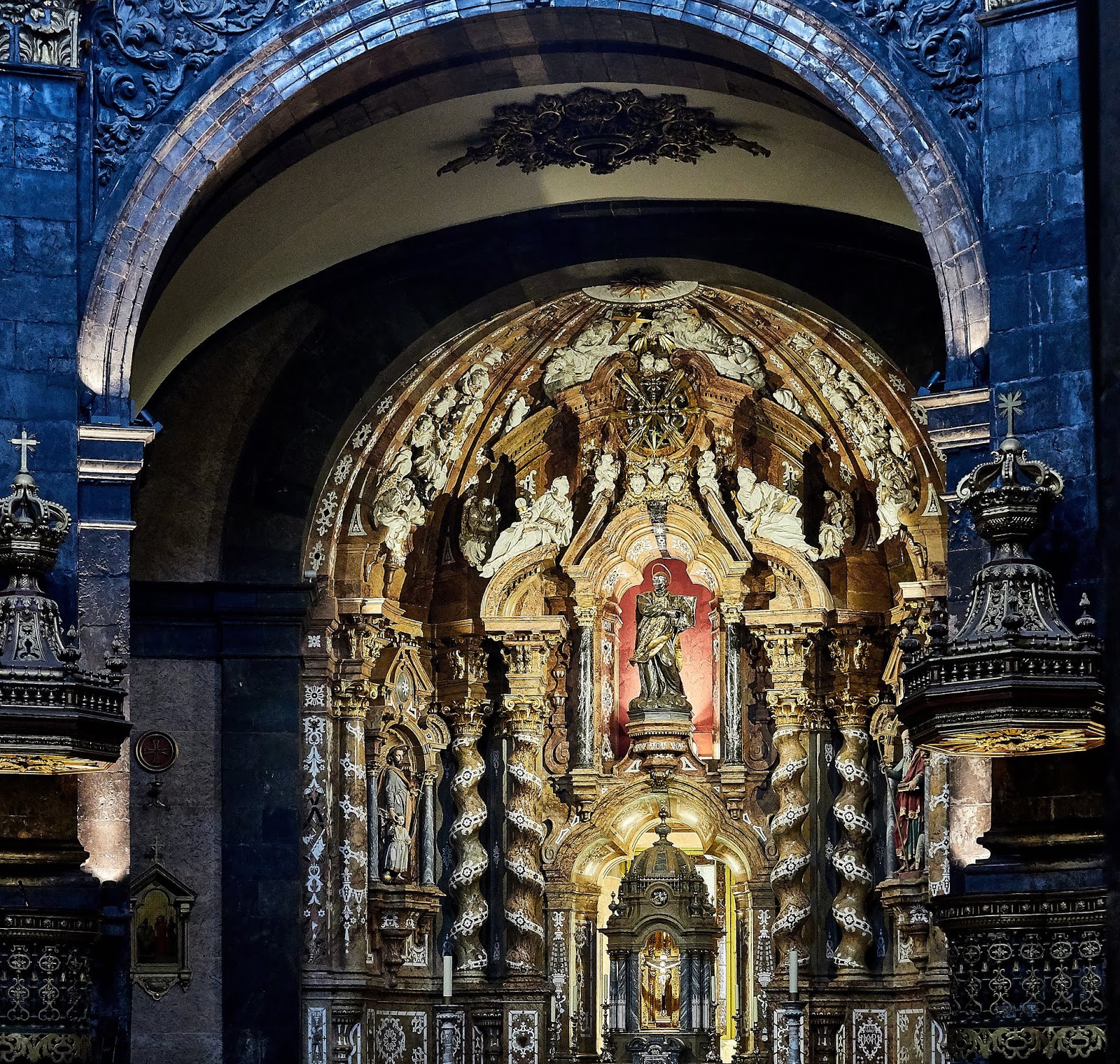
Main altar.  Nothing spared was the motto of the baroque. 

Am developing this thing for crystal chandeliers.  Would love to see this on lighted.  

Altar dedicated to Mary.  The basilica is huge. 

One of two pulpits. The lighting in the basilica is a challenge.  A lot of work in processing to tame things down and adjust color.  There is a very oddly placed spotlight that illuminates an IHS but makes no sense. 

Main altar.
The choir loft and organ.  There will be a closing Mass here on Monday.

Tabernacle door on main altar. I hoped to get another look at this today to figure out where the color originates on the host.  It is too uniform and outlined to be reflection.  The basilica is closed from 1 to 3.  By the time I was ready to return it was too close to the opening of the conference to have the time. 

+ Fr.Jack, SJ, MD

Sunday, June 9, 2019

To the twenty-two Jesuit priests ordained yesterday . . . and the newly ordained of other orders and dioceses.

This morning you awoke to your first full day as priests.  The memory of the past few days and of today, the day of your first Masses, must mark every day for the rest of your lives.  Arriving at this morning, particularly as a Jesuit, was a long process involving many steps, with the last two being ordination to the diaconate followed by yesterday's ordination to the presbyterate.  

Both ordination rites charged you with what you are to be, who you are to be, how you are to be, and why you are to be.  Both charges illuminated a dimension of the vocation to which you were called and which you accepted. Both are crucial to your vocations. 

During your ordination to the diaconate you knelt in front of the bishop.  He proffered one end of the Book of Gospels for you to grasp while he held the other.  And he charged you using the following formula:  

"Receive the Gospel of Christ, whose herald you now are.  Believe what you read, teach what you believe, and practice what you teach."

Yesterday at your ordination to the presbyterate you again knelt in front of the bishop.  He held the chalice containing wine and water with the host resting on the paten covering it. You held the chalice with him with one hand as the fingers of your other hand rested on the paten touching the host. Once again you were given a charge: 
“Receive from the Holy People of God the gifts to be offered to God. Know what you do, imitate what you celebrate, and conform your life to the mystery of the Lord’s cross.” 
If you keep both of these charges inscribed on your hearts and in your consciousness at all times the rest--be it teaching, social justice, practicing one of the professions, serving the missions, or even relaxing--will flow effortlessly.  

The charges you (and we older priests) received at ordination unite us in a common bond; from the hidden Carthusian celebrating his daily Mass in solitude, to the Holy Father celebrating in a stadium, to most of us offering Mass at a nursing home chapel, or parish, in the community, or the multitude of other settings in which we exercise our priesthood. 

Both charges began with the word 'receive.' We receive gifts, we receive news, we receive orders, mandates, and missions, we receive the Body and Blood of Christ.  The meaning of receive is multifarious.  Both of the charges began with the mandate, the order, the challenge, the demand, and the responsibility implied by the word receive.  Each involved a giver and a gift, each involves a recipient and a response.    
It seems fashionable to scoff at the idea of the ontological change, the fundamental change, in a man that is effected with ordination.  I suspect it still is among some.  But, appreciating and understanding that essential change that includes how you are perceived by others, (including close friends and family), as well as how you perceive yourself, is crucial to your priesthood. Each of you will have to figure out your relationship to that change for yourselves, just as every other priest has had to figure it out.  It is real. It is, like most dimensions of the spiritual life, difficult if not impossible to articulate and describe. Thus, you will struggle with this part alone.
There is a saying attributed to various sources that hangs in some sacristies. It should hang in every sacristy: "Priest of God, celebrate this Mass as if it were your first Mass, your last Mass, your only Mass."  It is good advice.  It covers everything you received yesterday.  Welcome.
____________________________________________
I was ordained twelve years ago today.  Yesterday in several locations in the U.S.and Canada, twenty-two Jesuits were ordained priests.  I wrote the above while recalling our ordination twelve years ago.  

The first set of photos are screen captures from the live stream of the ordination at Fordham.

The laying on of hands.  A deeply moving moment for all concerned. 

One of the newly ordained praying part of the Eucharistic Prayer for the first time.
Blessing the ordaining bishop, in this case Carinal Tobin.  
The cardinal kissing the hands he anointed only a little while earlier.   I almost became unglued when Cardinal O'Malley did this.  

Preparing to exit the church as priests. 

 Prostration twelve years ago.  St. Ignatius Church at the edge of the Boston College campus. 


Very near the end of Mass.  The reality was just making itself felt. 

 +Fr. Jack, SJ, MD

Thursday, May 30, 2019

Feast of the Visitation of the Blessed Virgin Mary

The Visitation of Mary to Elizabeth is a moment that makes the entire gospel more human, the kind of moment that could have occurred in any of our lives.  Reading between the lines fleshes out the story. 

Upon learning that she was to be the Mother of Jesus, Mary hurried to visit her relative Elizabeth. Elizabeth, the mother of John the Baptist, the herald who preceded Jesus, was in her sixth month of pregnancy. Kinship was understood differently in the Ancient Near East than it is in 21st century U.S. Thus, though referred to as cousins in some translations and kinswomen in others, we will never know the degree of relatedness between Mary and Elizabeth.  In the end, how they are related is irrelevant to the narrative. 

The journey from Nazareth to Hebron where Elizabeth is thought to have lived was not easy. While the distance was about eighty miles as the crow flies, it was closer to one-hundred miles when following the established roads.  To get an idea of that distance, walk out of the driveway here at St. Patrick, make a right and stroll until you get to Hartford, CT.

Someone traveling on foot could cover about twenty miles a day.  Thus, Mary's journey to visit Elizabeth took between five and seven days. As it is certain that she traveled with a group rather than alone the trek probably took closer to seven days than five, or perhaps more. The dangers of being on the road  were as much a risk then as they are today. 

So, there they were, a young girl and an older woman together for three months.  What did they talk about?  Did Mary stay until John's birth as pious legend holds or did she leave beforehand?  What did Mary think about on her return trip to Nazareth, a trip made while three months pregnant?

Mary's prayer, the Magnificat, is recited every evening at the close of vespers.  Over the centuries it has been set to music by many composers, with good reason.

"Magnificat anima meo Dominum
Et exsultavit spiritus meus 
in Deo salutaris meo."

"My soul proclaims the greatness of the Lord, 
my spirit rejoices in God my savior."  

There are certain lilies that can never be gilded.  Mary's Magnificatis one of them.  The prayer speaks of quiet contemplation and profound understanding of God's will. It is meant for the solitude of our souls and the silence of our hearts.  It does not require academic debate, acrimonious argument about whether it was adapted from Hannah's prayer, or a gender-neutral all-male-pronouns-removed feminist translation.  The Magnificatrequires nothing but daily repetition and frequent meditation. 

Mary and Elizabeth are examples of faith. They show us how to keep faith when things don't seem to  fit together. They are examples of faithful obedience despite dramatic change. They are models of fidelity for those who find themselves in places they never expected to be. 

Reread the Magnificat  later today.  Then spend some time sitting with these two women.  Listen to their conversation.  Pay attention to their silences.  Watch them go about their tasks.  Ask questions.  Offer to do the dishes.  

" . . . the Lord has done great things for me."

The Lord has done great things for all of us. 
____________________________________________

One of the challenges of the Church's liturgical calendar is that Easter and all of the related feasts are based on a lunar calendar (Easter is the first Sunday after the first full moon following the equinox) while the major feasts are fixed on the solar calendar. I will only point out that Christmas is always on 25 December with tongue firmly planted in cheek. Thus, this year the Feast of the Visitation of the Blessed Virgin Mary, which is always on 31 May, follows the Ascension (which is celebrated on Thursday in the Archdiocese of Boston, forty days after the Resurrection), by one day. 
It is a particularly favorite feast as I hope the homily makes clear.

A statue of the BVM at the monastery in VT.  It is quite small.  It is surrounded by wildflowers. 

 Wildflowers on the bank of the reservoir in VT.

No idea what kind of flower it is.  I call it purple.
+Fr. Jack, SJ, MD

Saturday, May 18, 2019

Homily for the 5th Sunday of Easter

Acts 14:21-27
Ps 145
Rev 21:1-5a
Jn 13:31a, 34-35

The reading from Acts sounds as if Paul and Barnabas could have benefited from GPS or MapQuest. They covered a lot of ground.  At times Acts has the sense of a travelogue meant to describe the difficult work involved in spreading the message of Jesus crucified and risen from the dead.  These readings represent the beginning of the Church's missionary life. 

Much was happening as the community of believers began to cohere.   Acts gives us the history.  Had this past Tuesday not been the Feast of St. Matthias with specifically prescribed readings, we would have heard the verse from Acts “and it was in Antioch that the disciples were first called Christians.”  

As Paul, Barnabas, and the others spread out the Church was gaining an identity and the believers gained a name. That name, Christian, would serve to give a concise description of the followers of Christ, a name that would accrue more and more associations—positive and negative—over the ensuing millennia. These associations to the word Christian emerged, and continue to emerge, from observations of how Christians conducted, and conduct, themselves in the public arena.   

This phenomenon of actions defining the name was well illustrated in a fine book by Rodney Stark titled, The Rise of Christianity: A Sociologist Reconsiders History,in which he studied the period roughly covered by Acts and extending into the first two or three centuries. (I read this about twenty years ago, it is a truly impressive book).  It is important to note for use in contemporary arguments that as per Stark, even in the earliest decades of the Church, the proscription against abortion, against adult men taking child brides, and the killing of the elderly, was absolute. The same, except for child brides, is found in the original Hippocratic oath written some 450 or so years before Christ was born. 

The first reading from Acts gives us history.  It is anchored in a specific time and location.  By contrast, the reading from Revelation indicates a point well-beyond the horizon and well-beyond history.  It tells us of what is to come.  The images are strange, but they are the only kind of images that can describe, or at least hint at,  that which we cannot know in this life. 

The reading does not tell us the how or the when.  But it assures us that we will be transformed in that instant upon death when we pass from life into eternal life.  We can take comfort knowing “there shall be no more death or mourning, wailing or pain for the old order has passed away.”  What greater consolation is there than to know that  pain, suffering, and sorrow will end.  

The Gospel brings us back to something I said earlier, something that Stark demonstrated in detail. Our identity as Christians, our identity as Catholics, is anchored in Jesus’ command at the end of the Gospel. “I give you a new commandment: love one another.  As I have loved you, so you also should love one another.”   That identity should be apparent if we follow Jesus’ command.  That is sometimes the problem.  It is difficult to live the command.  It is much easier to brag about it or proclaim it in song, even if the song is awful. 

Back in the seventies, a time during which some hideous hymns and songs were foisted upon the Church that inspired some of the greatest classical music ever written, one of the most annoying and wrongheaded songs--one cannot call them hymns--featured a thumping marching chorus and the stunningly narcissistic and self-aggrandizing lyric: “They will know we are Christians by our love, by our love. They will knoow woooo we are Christians by our love.” Sung too vigorously that last know-wooo sometimes sounds like the communal passing of a kidney stone.  
Musical value:  none.
Narcissism index:  too high to calculate.  

Perhaps if the verse were, they SHOULD know we are Christians IF they see our love, the lyric would be less grating, the sentiment less condescending, and more descriptive of a goal which we should share.  (Nothing will ever help the tune.)

There is, after all, nothing wrong with the conditional sense.  Rather than assuming that we manifest our love so perfectly that others will immediately see us as different, it is more realistic—and more humbling—to admit that we have to work at it.  The mere proclamation of ourselves Christians doesn’t mean that the love part derives automatically.  

The psalm assures us: 
“The Lord is gracious and merciful, 
slow to anger and of great kindness. 
The Lord is good to all
and compassionate toward all his works.”

This describes the Lord only.  We have to work very hard if we are to even barely approach the ideal.   
______________________________________________

Spring may have arrived.  Not entirely certain but it seems that the temps are up, the sun is out, and life is good.  BC graduates Monday.  Then things get quiet. 

I frequently go to Glastonbury Abbey in Hingham, MA, about one hours south of here on what is called The South Shore, to meet with one of the monks.  The BC conference center at Cohasset is about six minutes away.  Generally combine two trips into one.  Of course I periodically take the camera. 

The cross of one of the outdoor stations of the cross at the Abbey.  Bell tower in background.  I've not had a chance to explore the grounds but may try to do so one of these days.  

The Abbey just completed major construction and addition.  The monks only just moved into their new quarters. 

The Abbey Church.  I stayed for Mass this particular day.  That is something I am rarely able to do.  The sun was streaming through the window in the front making for some difficult photography.  Computer processing helped. 

The icon of Our Lady of Glastonbury.  Had to shoot at this angle because of the reflection from the sun hitting it.  

The gift shop sells Trappist Preserves (they are, after all, also Benedictine in heritage).  The pepper versions are fantastic.  I like spicy food and the monks at Spencer are not afraid of spice in their jellies.  They also do a red pepper one.  Great on the morning peanut butter and toast. 

Statue of St. Benedict holding his Rule for Monasteries, now more commonly known as the Rule of St. Benedict. 

Close-up of the book. 

The view from the second floor of Cohasset overlooking the harbor.  The gray building in the distance are part of the John Quincy Adams estate.  

 The harbor.  The Cohasset Yacht Club is further to the right. 

The Immaculate Conception overlooking the harbor.  

Love this kind of black and white photo.  A short essay in one photo. 

The crucifix in the house chapel at Cohasset. 

+Fr. Jack, SJ, MD

Monday, April 22, 2019

History repeated itself

Sacrilege on Easter 2019

It is sad that I must repost a version of this, but it happened again. I am perplexed, angry, embarrassed, and running through a number of other emotions, particularly in light of the Islamic terrorist bombing in Sri Lanka that killed three hundred Catholic and Protestant worshippers in coordinated attacks on yesterday.  The posting appeared last night.  The poster described it as a "little gentle humor for Easter."  It is not gentle or humorous; sacrilege is rarely either. It showed one of the many versions of the ancient icon of Christ the Pantocrator.  

The icon, of which there are many versions, shows Christ with His right hand raised, with the thumb and third finger making a circle and the other three fingers outstretched.  A book rests in the crook of the left arm.  The gaze is directed at the worshipper. That gaze locks the worshippers eyes in His.  It is difficult to look away. The book's pages are inscribed in Greek.  

On the offensive post the words of scripture were erased to create a blank space.  In place of the word of God is a hand shadow of a bunny meant to appear as if coming from Christ's hand.  One caption noted that it is the explanation of the beginning Easter bunny.  

When I posted a response two years ago one commenter suggested an overreaction because "Jesus must have a sense of humor."  That tickled my sense of humor right before the anger swelled. Rather than saying, thinking, or admitting that the drawing is inappropriate, he lapsed into the kind of projective defensive posture characteristic of children (see Anna Freud's The Mechanisms of Defense for a fuller explanation) followed by a few ad hominem attacks that included the accusation that I am a judgmental Pharisee.  I am not judging.  I am making a diagnosis.   There is a difference.  One must call pathology for what it is. 

Another sampling of  so-called humor for Holy Week appeared later in a poorly done depiction of Batman and Robin.  Balloon over Batman:  "Hurry for the washing of the feet." Robin replies: "Holy Thursday Batman."  Why?  That is the burning question.  Why must Catholics embarrass themselves, the Church, and the rest of us?  Has a certain type of Catholic, both vowed and lay, become so desperate to be seen as hip, cool, funny, with it, laid back, modernist, or entertaining--Don Rickles is dead, a replacement is not needed--that thought and reflection have been replaced by the kind of disinhibited behavior seen in drunks? They generally can't figure out the difference between appropriate and wildly inappropriate or between the sacred  and obscene.

Was there an icon of Christ the Pantocrator making the Easter bunny on the pages of Scripture anywhere in the two Coptic Church that were bombed on Palm Sunday in 2017 or in the Catholic Churches bombed yesterday in Sri Lanka?  Would the vanishing Catholic communities in the Middle East find amusement in a superhero cartoon characters mocking the rituals of Holy Thursday? 

I suspect one of the reasons people flee the Catholic Church or move into fundamentalist sects is the joking approach some ostensible Catholics and, tragically, some priests and religious, take toward it.  The level of disgust I had to struggle with last night made sleep difficult.  

In 2017 I received an e-mail from a friend who saw the original version of this post on my blog.  "I read your post. . .  I completely agree that our culture (many Catholics included) is off the rails concerning any recognition of the sacred. The profane and cynical is lauded in the media. Facebook is just another vehicle. When we name the sin of profanity, it is turned into intolerance (or just not getting the joke).  The right hand gesture in the icon you mention is very sacred. I went to a Byzantine Ukrainian high school where the priest's hand for blessing was formed in that manner. The fingers spell out the Greek letters IC XC which are the first and last letters of Jesus and Christ. It is truly blasphemy that the name of Jesus Christ is photo-shopped into a bunny."
Included below are photos of the icon of the Pantocrator (I did not take the photo) and an ecumenical service at sv. Jože in Ljubljana on Easter Monday 2017 (took several hundred photos that night by request).  It was attended by  Roman Catholic, Orthodox, and Byzantine Catholic men and women.  The principal celebrant was a Ukrainian Catholic priest assisted by a transitional deacon for the Ukrainian Catholic Church in Slovenia.  One of the Jesuits also concelebrated.  Note the priest's right hand extended in blessing at the end of the service.  

Father, forgive them, for they are totally clueless. 
_______________

Note the position of the fingers on the right hand.  I took this at an ecumenical Roman Catholic, Ukrainian Catholic, Orthodox service on Easter Monday in Slovenia in 2017.  The main celebrant was a Ukrainian Catholic priest.  He is blessing the congregation at the end of the service. 
+Fr. Jack, SJ, MD

Saturday, April 20, 2019

Easter

Acts 10: 34 a, 37-43
Ps 118: 1-2, 16-17, 22-23
Col 3:1-4
Jn 20:1-9

Haec dies quam fecit Dominus;
exsultemus et laetemur in ea "

“This is the day the Lord has made; 
let us rejoice and be glad in it.”  

These joyful words from Psalm 118 have been echoing through the universe and circling the globe for several hours.  Australia heard them first.  Then they flew over to inform Taiwan, Vietnam, and the Church in Mainland China. After passing through Asia and across the vast expanse of Russia they were proclaimed in Slovenia.  

"To je dan, ki ga je Gospod naredil, veselimo se ga in se radujmo"

They will not finish their flight across the U.S. for a few more hours.  By the end of the day the news of Jesus’ resurrection from the dead will have been proclaimed in every known tongue:  Chichiwa, Tagalog, and Portuguese, French, English, and Polish, Hindi, Swahili, and Mandarin

這是上主所安排的一天,我們應該為此鼓舞喜歡
(zhè shì  shàng zhǔ suǒ  ān pái de yī tiān 。
wǒmen yīng gāi wéi cǐ gǔ wǔ xǐhuān)

The first reading from the Acts of the Apostles summarized Jesus’ life. It began with His baptism and concluded with His death on the cross.  We heard the commission to the apostles to preach the message of salvation. It is the same commission we are given: to tell the world the message of salvation through Jesus act of self-surrender. That message is the reason we are to rejoice and be glad.  Jesus is the one set apart. Those who believe in him have forgiveness of sins through His name.   And so we are compelled to say:

“This is the day the Lord has made; 
let us rejoice and be glad in it.”  

As St. Paul so memorably wrote in the Letter to the Romans:  “God showed his love for us in that while we were yet sinners Christ died for us.”  

While we were yet sinners . . . Christ died for us.  

Jesus, fully Divine and fully human, Son of God and Son of Mary, Jesus who was like us in all things but sin, died for our sins.  He died because of our sins. He died to save us from those sins. 

We are sinners.  But, we are sinners who are passionately loved by God.  We were and are redeemed by Jesus’ passion and death.  That redemption was made manifest in His resurrection from the dead. What more can we say besides?

Este é o dia que o Senhor fez; 
alegremos e exultemos neste dia.

During the proclamation of John’s Gospel we heard of the disciple’s astonishment, confusion, sorrow, and fear when they discovered that the tomb in which Jesus had been placed three days earlier was empty. 

The last verse is instructive:  “Remember, as yet they did not understand the Scripture that Jesus had to rise from the dead.”  

". . . as yet they did not understand. . . ."  

Despite the years spent with Him the disciples still did not fully grasp who Jesus was.  That was going to change with the descent of the Holy Spirit at Pentecost.  But, for the moment the apostles and other disciples were perplexed.

The apostle’s confusion mirrors ours.  Despite the evidence of Jesus’ presence and action in our lives, we don’t always understand.  Unlike the apostles and other disciples, who lived the events recounted here in real time, we have scripture and the tradition of the Church to instruct us, guide us, and help us understand.  Still, we don’t always get it.  We sometimes fail to understand the gift Jesus is to us.  We sometimes fail to appreciate the gift he gave us. Thus, it is today, as it is every day, that we are called to pray, to meditate on scripture, and to receive the Body and Blood of Christ, truly and substantially present in the bread and wine, so that, unlike the apostles, we will understand, we will see, and we will believe. 

Last night, we gathered in front of this church to bless the new fire from which we lit this exquisite paschal candle.  The formula pronounced while inscribing the candle explains everything. 

“Christ yesterday and today 
the beginning and the end. 
Alpha and Omega; 
all time belongs to him, 
and all the ages; 
to him be glory and power, 
through every age for ever.” 

'Haec dies quam fecit Dominus;
exsultemus et laetemur in ea.'

This is the day the Lord has made, 
let us rejoice and be glad.

And we respond with perhaps the only word which all of the languages of the world understand and hold in common. 

Alleluia
Alleluia
Alleluia. 

________________
The homily is for tomorrow morning.  Because of the length of tonight's Mass at the Abbey the homily is going to very short.  

The holy oils for the coming year

The Carthusian motto applies here:  The Cross stands firm while the world turns

Holy Water ready for blessing

Christ, the Dawn 

Blessed Easter
+Fr. Jack, SJ, MD

Friday, April 19, 2019

Good Friday

Good Friday 

'Stabat Mater dolorosa
Iuxta Crucem lacrimosa
Dum pendebat filius'

At the cross her station keeping
Stood the mournful mother weeping
Close to Jesus to the last.

The 13th century  Stabat Mater Dolorosa is one of the greatest of all Latin hymns.  It has been set to music by composers ranging from Palestrina in the 16th century to Dvořák in the 19,th Poulenc and Szymanowski in the 20,thand Muñiz and Jenkins in the 21st.  The hymn meditates on the sorrows of Mary, Mother of Jesus.  It recalls the sorrows prophesied by Simeon at the presentation in the Temple.  Each verse recounts the sorry scene as Mary stood at the foot of her Son's cross--the "sign that is spoken against" that she heard of in Simeon's prophecy years earlier.  

'Cuius animam gementem, 
Contristatam et colentem, 
Pertransivit gladius.'

Through her heart, His sorrow sharing, 
All His bitter anguish bearing, 
Now at length the sword had passed.

Place yourself there. Go to Calvary and enter into the scene John described.  Jesus, hanging on the cross as life ebbs from his body. Mary, His Holy Mother, watching as Simeon's words echo in her ears. The beloved disciple helpless and hopeless at the loss of all he had found in Jesus.  How does Jesus' voice sound?  Is it strong? Or does he struggle to speak in a hoarse whisper? Is Mary standing erect and stoic?  Or is she collapsing under the unique and terrible grief of a mother watching her son die?  What of John? Does he remain standing in the same place?  Or does he move closer to the woman who is now his mother?

Recall that Jesus said: "Behold your mother."  He did not say "my mother."  He said "your mother."  In this charge and in his words to Mary,  "Woman behold your son," Jesus confirmed Mary's role as the new Eve, mother to us all, a mother whose obedience reversed Eve's disobedience,  a reversal effected when she said:

"Behold, I am the handmaid of the Lord; 
may it be done unto me 
according to your word." 

'Pro peccatis suae gentis
Vidit Iesum in tormentis, 
Et flagellis subditum.'

For His people's sins rejected,
Saw her Jesus unprotected, 
All with bloody scourges rent.

Remain there contemplating the scene.  Gaze up at Jesus suspended between heaven and earth. He is close to death,  exhausted by the struggle,  haggard,  dehydrated, pale from blood loss. 

At the beginning of the Spiritual Exercises, Ignatius instructs us in what is known as the triple colloquy: Imagine Christ our Lord on the cross. Ask yourself how, Jesus is come to make Himself man,  and so to die for my sins.  Likewise, looking at myself ask: 

What have I done for Christ?
What am I doing for Christ?
What ought I to do for Christ? 

However, today, as we commemorate Christ's passion and death, there is another colloquy: 

What has Christ done for me?
What is Christ doing for me?
What will Christ do for me?  

While we could probably come to some sort of agreement on the first question, the answers to:  what is Christ doing for me and what will Christ do for me,  will be unique to each of us.  Perhaps we will never be able to fully articulate those answers.  They may have to remain fragments we can experience only in silent prayer rather than as words we can share.  

'Fac, ut ardeat cor meum, 
In amando Christum Deum, 
Ut sibi complaceam.'

Unto Christ with pure emotion, 
Raise my contrite heart's devotion, 
To read love in every wound.

We are sinners  loved passionately and completely by God.  We are loved by God who sent His only Son born of Mary, she who stood at the foot of the cross.  We are loved by God who sent His only Son to die for our sins and the sins of all the world. 

Three and one-half months ago we gathered to celebrate Jesus' birth.  Were we not gathered here today to commemorate his passion and death, what we call the Christmas story would make no sense.  Were we not here today, the story of Jesus' birth would be nothing more than a charming fable without meaning. The trumpet fanfare of Christmas Eve is a faint memory.  But it foretold what Christ did for us. 

"We adore thee O Christ and we bless thee,
Because by thy Holy Cross Thou hast redeemed the world."\
___________________________________________
Just finished the liturgy at the Abbey of Regina Laudis.  It is quite strenuous.  Fortunately I had a younger priest-friend here with me  .  .  . wayyyy younger.  He carried the cross used for the veneration.  The cross is not large but it is extremely heavy.  Last night he helped with the foot washing.  I washed the feet of the first six and he did the second six.  My legs were thanking me.  

Spring is hitting New England.  Took the enclosed photos over the past two days.  Forecast for Holy Saturday is not the greatest.  Hoping that it does not rain while we are lighting the fire from which the paschal candle is lit.  

The magnolias are coming into blossom.  There is really nothing more to add. 


+Fr. Jack, SJ, MD