Saturday, July 9, 2022

The Prodigal: Homily for the 15th Sunday in Ordinary Time

Lk 10:25-37 (The Good Samaritan)


The parable of the Good Samaritan evokes an image which, along with the Prodigal Son, is part of common English usage. Images that may even be used 

by those who profess no faith or who are militant atheists. It places significant burdens on our shoulders to notice, to care, and to act.   They are the burdens of being an instrument of God’s justice.  Two factors separate the Samaritan’s actions from a mere good deed: risk and commitment.  The Samaritan took a risk when he stepped outside the script and intervened to help another. He bound himself to the anonymous victim through an act of love.  


Hate is not the opposite of love.  The opposite of love is apathy or indifference.  

Apathy was the sin of the passers-by who either didn't care enough to notice or noticed but didn't care enough to get involved. Things haven't changed.  During psychiatry residency I got to witness a modern reenactment of this parable. 


The psychiatry department was on the second floor of an awful building across the street from the busy Tioga St. entrance to Temple University Hospital.  I was looking out the window contemplating the scene below at lunch time. The usual food trucks lined the street.  Patients, families, white-coated physicians, and scrub suited staff passed by in all directions.  Then the drama unfolded. 


A young man and his mother, both of whom appeared to be developmentally disabled, were seated on a bench eating the hot dogs they had purchased from one of the trucks.  The woman suddenly started to cough and choke.  Her son was gesturing and calling frantically for help.  Two ear, nose, and throat physicians—I use the term physicians sarcastically in this case—passed within feet of the boy but continued walking as if they heard and saw nothing.  Other docs and nurses ambled by as well, ignoring the mini-drama.  


Then one of the docs, whom I knew, and a student going over to the hospital, raced up to the boy and his mother.  The doc did the Heimlich maneuver.  The student ran into the hospital and emerged with a wheelchair.  They put the coughing woman into the chair and raced into the ER with her son running behind.  


I spoke with the doc and the still shaken student later. They were both rattled by the inaction of the ENT residents and by the response of the ER docs who told the student they could not go out of the ER to help a patient.            


Unlike the others, the doc and student got involved.  They noticed and cared about what was happening.  They acted without weighing risks of a malpractice suit.  They did not worry about hospital policy or looking like idiots doing the Heimlich in the middle of the Tioga Street Plaza. They cared for someone in need.


There is something more in the parable. In addition to the risk of helping a stranger in acute distress the Samaritan made a commitment that extended into the future.  This was not an example of the ridiculous bumper sticker: “Commit random acts of kindness and senseless acts of beauty.” There was nothing random or senseless about the Samaritan’s action. “Look after him, if there is any further expense I will repay you on my way back.”


Suppose the two pieces of silver didn't cover the expenses. What if the Samaritan didn’t return  because he forgot or took a different route, or was himself the victim of robbers.  The anonymous victim would have been stuck with the bill.  As he had been robbed of everything, he would have been put in debtor’s prison until he was able to pay up.  What does it cost someone when we break a commitment?  What happens when we renege on a promise?  What does it cost us when we don’t honor a commitment?


Like Jesus’ other parables the Good Samaritan is frustrating because there is no set conclusion. It is like seeing only the first act of a two-act play or finding that the last half of a mystery novel has been ripped out.  That incompleteness is an advantage, however, that allows us to insert ourselves into the parable and explore its meaning.  We can meditate on possible outcomes and scenarios without a set conclusion. We are not trapped by the equivalent of “and they lived happily ever after.”  We don’t know if the Samaritan kept his word and returned.

or if the innkeeper fulfilled his part of the deal. If we are being honest with ourselves, however, we do know that too often we do not keep our word or fulfill our part of a deal.


The good news is that we can be certain that Jesus keeps His word to us.   We know that Jesus’ commitment to us has never wavered. It will never waver.  He will never fail to honor the promises he made to us. We only have to ask. We only have to go to Him in prayer and we will be cared for.  


No silver pieces needed to settle the account.

______________________________________________________

I was in Lyon on 14 July 2014 for the fête nationale française.  We lived two blocks from the bridge to the Old City of Lyon in what had been the Visitandine Monastery in which St. Francis de Sales died.  The weather was perfect.  I was on the street all day with my camera.  At night I went the two blocks to the river, set up a tripod and camera and shot away.  It was my first time shooting fireworks.  Was grateful I had the tripod with me.  The firework shots are self-explanatory, no explanation necessary. 

Beats the little wands and bottle of dishwashing liquid.  The maker was using a large wire loop and two long wooden dowels.  He waved it through the air. 

The Basilica Notre Dame de Fourvière that overlooks the city.  Fireworks were shot off nearby with the basilica forming the backdrop.

My kind of hotel.  Keep the glass and chrome I want something like this.

Lyon is the capitol of French cuisine.  Sidewalkcafes all over the old city

The Basilica at sunset.  

The kebab stand.


+ Fr. Jack, SJ, MD

Saturday, July 2, 2022

Standing at the Foot of the Cross: Homily for the 14th Sunday in Ordinary Time

Isaiah 66:10-14c

Psalm 66: 1-3,4-5,6-7, 16, 20

Gal 6:14-18

Luke 10:1-12, 17-20


The reading from Galatians consists of the last four verses of the letter.  

As such, it functions as a summary of Paul’s message.  The reading begins with the well known statement: 

“But may I never boast except in the cross of our Lord Jesus Christ, 

through which the world has been crucified to me and I to the world.”   


In just a few words Paul described  the radical change brought about by Jesus’ crucifixion: change in the universe, change in the world, change in Paul himself,  and, one hopes, change in us who responded to Jesus' summons: "Follow me." 


Paul’s sentiments are neither surprising nor out of step with his other writings.  

The verse recalls Paul’s second letter to the Corinthians where he wrote: “I will rather boast most gladly of my weaknesses, in order that the power of Christ may dwell with me.  Therefore, I am content with weaknesses, insults, hardships, 

persecutions, and constraints, for the sake of Christ; for when I am weak, then I am strong.”   


The late Jesuit scripture scholar Fr. Stanley Marrow frequently reminded 

students at Weston Jesuit School of Theology--he had to because they continually forgot--that Paul’s theology began at the foot of the cross and no where else.  We must always recall that our lives as Christians is lived

at the foot of the cross, the shameful, insulting, degrading and scandal causing 

instrument of Jesus' death. 


The Spiritual Exercises of St. Ignatius begin at the foot of the cross. In the first exercise of the first week one is given the instruction: “Imagine Christ our Lord 

suspended on the cross before you, and converse with Him in a colloquy. . . .

Reflect on yourself and ask:  What have I done for Christ?  What am I doing for Christ”  What ought I to do for Christ?”   


We are born as Christians at the foot of the cross, not at the feet of the Risen Jesus, not at the entry to the empty tomb.  We are born as Christians at the foot of the cross, not gazing up at Jesus as he ascends, not standing alongside Jesus 

as he heals the sick, nor sitting next to Jesus as he repeats the Beatitudes of the Sermon on the Mount.


We are born at the foot of the cross on which Jesus hung in agony, the cross on which he was an embarrassment to those who followed him.  It was his same Jesus who sent the disciples out on missionwith detailed instructions on dress, baggage, accommodations, how to comport themselves in the towns and homes in which they stayed. He also instructed them in what to do if they were rejected

or their message was ridiculed.  Accommodating their message to conform with message of those who ridiculed it was not among the options.  Some things must remain non-negotiable.


There is an endearing quality in the group's reactions as they returned

from their mission.  “ . . . rejoicing and amazed that even the demons were subject to them because of Jesus’ name.” 


Healing another is exhilarating no matter if one is a junior medical student on his or her first rotation, or a white-haired physician with decades of experience. 

The description of the return of the seventy-two suggests a group of medical students returning from their first day on the wards, babbling on and on to each other about what they saw, did, and learned. 


Would the disciples have acted differently, or been less effective, had they known that the one to whose name demons were subject, the one from whom they received their mission, was going to die the shameful death reserved for the lowest of criminals?  We know that their behavior when Jesus was crucified 

was less than admirable.  Would they have been disillusioned had they known what was to come?  Would they have preferred a Jesus who was a political-social activist, a military liberator from Roman domination, or the kind of all around nice guy who never challenged their assumptions about their own goodness and and for whom anything was acceptable if it could be framed in the language of love?


We cannot afford to be ashamed of Jesus’ death on the cross and all that grew from it. We cannot minimize the horror of that death. We cannot replace the reality of Jesus' death with something more palatable to modern or post-modern sensibilities.  


It is the crucified Jesus who is the center of the mystery of faith.

It is in the name of the crucified Jesus that the Church preaches,  

It is under the sign of the crucified Jesus that the Church heals the sick, 

comforts the sorrowing,  ministers to the poor,  and absolves us of our sins. 


If we remain at the foot of the cross asking the three questions from the colloquy:

What have I done for Christ? 

What am I doing for Christ?

What ought I to do for Christ?  

we can proclaim with the psalmist: 

"Hear now, all you who fear God, 

while I declare what he has done for me. . . ." 

__________________________________

Over the past months I have been going through thousands of photos as I move everything from a collection of USB drives, one of which is on its last legs, to a solid state drive that has a much larger capacity and a much smaller footprint such that it resides in a pouch glued to the laptop.  I can pull out the program to edit whenever needed.  The photos below are from 13 years ago.  I took them during the eight-day retreat I made at St. Joseph Abbey in Spencer. The retreat ended two days before I pronounced solemn vows in the Society of Jesus on 1 October 2013. It was a perfect retreat.  Indeed, it is unlikely I will ever make another retreat there.  No way could I recapture the perfection of all its dimensions.  I go out to visit two of the monks who have been friends for decades but I no longer need to stay over.  

The Salve window.  It is lit from behind so that it is visible in the winter dark.  Compline is sung at Spencer at about 7:30 PM.  Well after dark in New England after DST ends.

The kind of still life I am always seeking out

The main door to the church as seen from inside the enclosure.  I was staying within the enclosure and thus had access to all of the area.

Early in the AM on the day I departed.  

The tabernacle and altar.

The abbey and graveyard. 

+Fr. Jack, SJ, MD

Sunday, June 19, 2022

Five Times Through the Three-year Cycle of Readings: Homily for the Solemnity of the Body and Blood of Christ

Gen  14:18-20

1 Cor 11:23-26

Ps 110

Luke 9:11b-17


Jesuits are described as contemplatives in action.  Unlike our Trappist brothers who live in monastic cloister and silence, contemplating the word of God, we move around a lot.  Just ask my mom how many phone numbers and addresses I’ve had in my ten years as a Jesuit (it is now 25).  She used to carefully erase the old one before putting the new one in her address book.  Now she uses a recycled sticky note. 


It has been said that the Jesuit cloister is the highway.  Our oftentimes mobile work, drives our prayer life and our prayer life, oftentimes entered into while on the move,  drives our work.  Overall, action seems to trump contemplation most of the time.  


But a feast such as the Solemnity of the Body and Blood of Christ reminds us of the contemplative side of our lives.  Not just Jesuit lives.  But the lives of all believers.  The Solemnity of Corpus Christi pulls us into the contemplative because It is an abstract feast that doesn’t recall a specific event.  


The Church’s liturgical calendar is crammed with solemnities and feasts—Christmas, Easter, The Ascension, The Annunciation—that recall specific events in the history of salvation, feasts that recall specific moments in the history of the world.   They are events with a narrative flow.  There is a story that is told and retold.  We can place ourselves in the action, we can participate in the narrative.   We can close our eyes and, with only a little imagination, see the events unfold on an inner movie screen.  


However, on this feast we have to sit in silence.  There is no script.  There is no “story line.”  We are called to contemplate a dogma of faith.  


We don’t contemplate an event in the life of Jesus but the gift of Christ truly and substantially present in the eucharist.  It is overwhelming to consider Christ present in the bread and wine that we receive. It is overwhelming to recall Christ present in the eucharist that we adore on the altar.  The Real Presence is a stumbling block for some.  They can understand symbol.  They can understand sign.  They can understand metaphor.  They simply can’t understand real.  


The bread of life appears in the three readings and the psalm.  


It is a happy moment to hear the name of Melchizedek less than twenty-four hours after being ordained. “You are a priest for ever, in the line of Melchizedek.”  Melchizedek is a mysterious figure.  There is no history about him, there is no genealogy tracing his descent.  All other references to Melchizedek derive from this single mention in Genesis.  


The reading from Paul’s letter to the Corinthians includes the words of consecration, the words, the formula, the action, that bring us here daily.  Elaborating on these words, trying to explain them in greater depth, would be either gilding the lily or taking more risks than a priest should at his first Mass.  


The feeding of the multitude from little is a challenge.  How did it happen?  What were the physics, the chemistry, or the economics of such a miraculous event?  


How is not the relevant question. 


The import of this gospel narrative is that when we are hungry and when we thirst on the journey of our lives, Christ is present to us in the eucharist.  Christ is there to restore and refresh us.  


We just heard in the Gospel, “they all ate until they had enough.”  The feeding the multitude from very little, reminds us—it was in fact a preview of what was to come—that from the  small piece of bread that he broke the night before he died Jesus has nourished, and will continue to nourish, untold billions, generously and completely.


The Body and Blood of Christ is an unending source of nourishment, sustenance, and comfort.  The only thing we can do on this feast is to sit in awe and contemplate this great gift.  The only thing we need do is to receive the Body and Blood of Christ and then continue on the journey.

________________________________________


The Sunday lectionary or the book of readings for Mass is laid out on a three year cycle designated as year A, B,, or C.  In year A the predominant readings are from Matthew, B from Mark, and C from Luke.  This year is Year C in the cycle.  I celebrated my first Mass the day following ordination on this feast 15 years ago, 10 June 2007.  It too was year C.  Thus, in 15 years I’ve made five cycles of the lectionary, still discovering new things.  


Was up in Vermont for several days.  Got back last night around 8:00 PM pretty much exhausted.  However, pushing to drive last night seemed a better idea than leaving on a 3 ½ hour trip at 6:00 AM, knowing that I have a Mass at 11:15. 


Weather in VT was not great but did get a little shooting in.  Very little.  

Bee on a daisy

A few wildflowers on the banks of Lake Madeleine

Gilbert and Sullivan fans please sing along . . . 

An empty road running through the valley halfway up the mountain

Shadows of glasses in a glass cabinet in a mid-century  kitchen

The glass cabinet and the shadows

Saturday, June 11, 2022

In the Name of the Father: Homily for the Solemnity of the Holy Trinity

Dt 4:32-24, 39-40

Ps 33:4-5,6,9,18-19, 20,22

Rom 8:14-17

Mt 28:16-20


We recall the Most Holy Trinity at the begining and end of every Mass.  We invoke the Trinity every time we pray.  We call upon the Trinity whenever we say the words:  Father, Son, and Holy Spirit.  What we call the sign of the cross or the Trinitarian formula is critical to every sacrament from baptism to the anointing of the sick and dying.  This sign begins and ends everything the Church does.  


We read in The Catechism of the Catholic Church, “Christians are baptized in the name of the Father and of the Son  and of the Holy Spirit "Catholics, in particular, are NEVER baptized, or to be baptized,  by a whacked-out priest or deranged deacon—both have happened—using the bizarre formula: in the name of the Creator, the Redeemer and the Sanctifier.  If that formula is used the pseudo-sacrament is invalid and the child must be baptized using proper form.  Politically correct or so-called “gender sensitive’ rewording liturgically illegitimate and forbidden.  The Catechism continues,  "The mystery of the Most Holy Trinity is the central mystery of Christian faith and life. It is the mystery of God in himself. . . .It is therefore the source of all the other mysteries of faith . . . It is the light that enlightens them. . . . It is the most fundamental and essential teaching in the hierarchy of the truths of faith.”  


Every time we make the sign of the cross throughout the course of a day, we recall an unfathomable mystery, a mystery that can be neither explained nor dissected.  The Trinity remains inexplicable despite the vast number of books written about it.  Though each book may contain a tiny insight into the nature of the Trinity, no book captures the essence of the Trinity.  The sum of all books written about the Holy Trinity, will ever capture its essence.  In the final analysis, the dogma of the Trinity depends on faith and faith alone. 


Faith does not rest  on logical proof or material evidence. As Paul instructed in his Letter to the Hebrews: “Faith is the conviction of things unseen.”   We must become comfortable with faith as mysterious because despite the absence of logical proof, despite the impossibility of philosophy or science  to truly explain the Trinity, there is no Christianity without the Trinity.  Father.  Son.  Holy Spirit.


As a legend about St. Augustine holds, he was walking along a beach trying to understand One God in Three Divine Persons through logic.  He noticed a little boy digging a hole in the sand. The kiddo was walking back and forth between the water and the hole with a seashell filled with seawater.  After emptying the shell it into the hole he returned to the water for more.  Augustine observed him for a while and then asked what he was doing.  The boy replied that he was

emptying the sea into the hole.  Augustine asked how he could hope to empty the sea into a small hole?  The child responded, “I can empty the sea into this hole more easily than you can understand the Trinity.”  The message behind this legend is a reminder that there are things the human intellect will never grasp.

Even if we were to comprehend the Trinity, the limits of human vocabulary, the emptiness of all languages, the pallid nature of similes and metaphors, would prevent us from explaining it to anyone else.


The word Trinity does not appear in the Bible.  The understanding of the Trinity grew as the Church began to consider what Jesus had said and done during His time on earth. The doctrine of the Trinity is the doctrine that in the unity of God there are three Persons: Father, Son, and Holy Spirit. There is only One God, yet the Persons are distinct. Thus, Jesus always speaks of His Father as distinct from Himself but He also notes that “I and the Father are One.”  The same is true of the Holy Spirit.


The Trinity is, and will remain, a mystery.  The doxology: "Glory be to the Father, and to the Son, and to the Holy Spirit, as it was in the beginning, is now, and ever shall be; world without end.  Amen" reaffirms that fundamental truth of our faith. It can also fuel hours of contemplation

 ______________________________________________

Sometimes I choose photos strictly for color with no attempt to be coherent as to place  etc. This is one of those times. 


+ Fr Jack, SJ, MD


Saturday, June 4, 2022

Come Holy Ghost, Creator Blest: Homily for the Solemnity of Pentecost

 Acts 2:1-11

Ps 104

1 Cor 12:3-7,12-13

Jn 20:19-23


The word Pentecost derives from the Greek meaning ‘fiftieth day.'  The word is not unique to the Church. Today's solemnity is historically, symbolically, and, as it began at sunset yesterday and will and at sunset tomorrow, it is calendrically linked to the Jewish celebration of Pentecost, also known as Shavuot. 


Shavuot commemorates God's giving the Torah to Moses on Mt. Sinai fifty days after the Exodus.  It falls fifty days after the first seder of Passover, always between May 15th and June 14th.  In the Catholic liturgical year Pentecost is celebrated on the fiftieth day after the Solemnity of the Resurrection of the Lord, no earlier than May 10th or later than June 13th.  Just as Moses received the wisdom and teaching of the Torah fifty days after the Exodus, the Church received the wisdom and teaching of the Holy Spirit fifty days after Jesus’ exodus from death. 


The first reading is dramatic. Wind.  Fire.  Speaking in tongues. An ideal scene for a Cecil B. DeMille movie.  The people were shocked when they heard the unsophisticated Galileans speaking in whatever language necessary to tell the city's many visitors the Good News of Jesus.  The speaking in tongues is sometimes referred to as “the reversal of Babel,” the undoing of the event that caused the earth's multiplicity of languages, a symbol of disunity.  At Pentecost, that which had been split apart by human pride at Babel was reunited through Jesus’ obedience to the Father.  That which had been shattered by hubris was reassembled by Jesus, who sent the Holy Spirit as He had promised.


As Paul wrote to the Corinthians, “To each individual the manifestation of the Spirit is given for some benefit.”  He listed some of those gifts in his Letter to the Romans. Today we celebrate the giving of those gifts.  Each of us receives unique gifts of the Holy Spirit that are not identical or interchangeable with those of another.  Our task is to discover and develop our unique gifts throughout life.  


In some parts of American society it is fashionable, indeed it is a form of virtue signaling and wokeness, to deny even the possibility--to say nothing of the reality--of differences and distinctions, of abilities and inabilities, of truth and mistruth.  The risk of not hewing to, teaching about, or preaching the narratives du jour may result in job loss, demands for public mea culpas and penances, or cancellation, the American version of Solzhenitsyn’s Gulag


Today, many choose to deny fundamental biological differences with delusional intensity.  Apparently the mantra “follow the science” is demanded only under certain conditions while it is optional under others. Denying differences fuels a heightened sense of specialness in which each individual or faction insists that his, her, or the group's specialness must be recognized as the most special of all forms of specialness, even to having a day, week, or month dedicated to trumpeting that specialness.


One of my physiology professors at Temple shared a parody about the body

in which the general outline was an argument among organs and body parts 

as to which was the most important, which was the supreme controller, which was the MOST critical to the body’s function, comfort, and survival. It was long, it was hilarious, and it cannot be repeated in sacred space.  However, the main point was that there is no MOST important organ.  All of the body's organs and organ systems are equally necessary to life.  Each has unique functions that cannot be replaced or substituted by another.  The lungs cannot do the work of the liver, the liver cannot do the work of the heart,  and the pancreas definitely cannot become kidneys. 


One of the most dangerous lies ever told is: "You can be anything you want to be." No one can become anything he or she wants to be simply by wanting to be that thing, or, in current terminology, by self-identifying as it. All of us have certain immutable limits determined by chromosomal and genetic makeup, anatomy, and physiology as well as many other factors. All strengths are balanced by weaknesses.  Native abilities are enhanced by inabilities, potential in some areas is balanced by a complete lack of same in others.  The only equality among humans is that all are sinners loved by God. 


Comparing the account of Pentecost in Acts with the account of the Holy Spirit’s descent as narrated in John's Gospel may be confusing. "When the time for Pentecost was fulfilled, they were all in one place together." The descent of the Holy Spirit in Acts was clearly fifty days after Jesus' resurrection.  "And when He had said this,  He breathed on them and said to them, "Receive the Holy Spirit." John's Gospel seems to indicate that the disciples received the Holy Spirit

soon after the Resurrection while Jesus was present among them.  How does one reconcile the two accounts?  There is no need to do so. 


Yesterday's gospel ended with the final verse of John's Gospel:  "There are also many other things that Jesus did, but if these were to be described individually, I do not think the whole world would contain the books that would be written."  We cannot and must not isolate discrete moments or episodes

from what is one integral event, the event of Jesus' revelation of the Father. 


As the late Jesuit Father Stanley Marrow explained, "He who dies on the cross, 

is he who rises from the dead, returns to the Father who sent him, and sends his Holy Spirit on all who confess him as Lord and Son of God.”  The gifts and graces of the Holy Spirit have been bestowed on us. That is all we need to know. 

The logistics are unimportant.


Our task is to cooperate with those gifts and graces in the manner to which each of us is called. 


Our mandate is to share the news of Jesus with those whom we meet in whatever language necessary.

__________________________________

The photos are black and whites taken in Lyon, France in the summer of 2014.  Terrific city, superb food and a Jesuit community in an excellent location, a short walk across the river.  Wandered around most Saturday mornings.  Didn't entirely feel comfortable walking around late at night as much as I did in Ljubljana or Taipei.  


Fr. Jack, SJ, MD

Sunday, May 15, 2022

What's in a Name?: Homily for the 5th Sunday of Easter

 Acts 14:21-27

Ps 145

Rev 21:1-5a

Jn 13:31a, 34-35


The first reading from Acts gives us history  anchored in a specific time and place.  Among other things it suggests that Paul and Barnabas could have benefited from GPS or at least a good travel agent.  They certainly covered a lot of ground in the first missionary efforts of the Church.  At times Acts is a combination travelogue and introductory course in missiology. It describes the difficult work of spreading the message of Jesus crucified and risen from the dead to the world well-beyond Jerusalem.  Acts describes the challenge of sharing the Good News with those who would not have heard it otherwise.  


Much was happening as the community came together, growing in leaps and bounds.  It developed a unique identity such that in the reading on Tuesday we heard  “For a whole year they met with the Church and taught a large number of people, and it was in Antioch that the disciples were first called Christians.”  


"and it was in Antioch that the disciples were first called Christians."


As Paul, Barnabas and the others spread out in their missionary efforts, what came to be known as the Church was gaining a foothold, and the believers were given a name. That name would serve as a concise description of these people. 

It was a name that would accrue more and more associations—both positive and negative—over the ensuing millennia. 


Associations to the word Christian emerged, and continue to emerge, from observations of how Christians conducted-- and continue to conduct--themselves 

in the public arena,  even when 'being a good Christian' is used to advance an immoral agenda. There is nothing Christian about the intentional taking of human life at any point from conception to natural death in old age.   


That religious belief has a profound effect on behavior was well illustrated in Rodney Stark's book: The Rise of Christianity: A Sociologist Reconsiders History.

The book considers the period covered by Acts and into the first two or three centuries of the Church, a rather narrow span of time given the two millennia of Church history. 


Stark described behaviors in the early Church that he contends drew many to embrace Christianity.  One of the most fascinating was the Christian community's response to plague.  From the very beginning Christians acted on the mandate 

to care for the sick.  Stark suggests that caring for the afflicted diminished the community's incidence of plague as a result of immunity developed from low-level exposure to the infectious agent; a primitive form of vaccination if you will.  In addition; the nascent Christian Church held, even then, absolute prohibitions against the taking of child-brides and against abortion.   


If the first reading from Acts gives us a history.  anchored in time and place,  Revelation indicates a point well-beyond the horizon anchored neither in time nor geography.  It hints at what is to come in veiled language.  The images are strange, but strange is the only way to describe that which we cannot know in this life.  The reading does not tell us the how or the when.  But it assures us 

that we WILL be transformed in that instant when vital functions cease and everything changes.  We are reminded of this in a preface for the funeral Mass: 

“Lord, for your faithful people life is changed, not ended. . . . It is a great comfort knowing “there shall be no more death or mourning, wailing or pain for the old order has passed away.”    Pain.  Suffering.  Sorrow. Those experiences that mark our lives on earth will come to an end in that final moment.  


The Gospel brings us back to the meaning of Christian, and associations people make upon hearing the word Christian.  Our identity as Catholics, is anchored in Jesus’ mandate.  “I give you a new commandment: love one another.  As I have loved you, so you also should love one another.”  Christian identity should be apparent in those who follow Jesus’ command.  But, because we are sinners, that identity is not always visible.


Back in the seventies, a time during which some truly awful church songs were foisted upon us, and which, alas, remain firmly implanted in cheap, ugly, disposable "worship aids" and loose-leaf lectionaries, one of the most annoying and wrongheaded featured a thumping marching chorus and the stunningly narcissistic self-aggrandizing lyric: 

“They will know we are Christians by our love, by our love.

They will knoow woooo  we are Christians by our love.” 


That last know-wo sometimes sounded like the communal passing of a kidney stone.  

Musical value:  close to zero

Theology:  little to none.

Narcissistic index:  like American Express, priceless


Perhaps if the verse read, 'they SHOULD know we are Christians by how we show our love,' the words would be less grating, the sentiment less condescending, and more descriptive of a goal which we should seek.  

There is nothing wrong with the conditional sense.  Rather than assuming 

that we manifest our love so perfectly that others will immediately see us as different it is more realistic—and humble—to admit that we have to work at it.  

Just because we proclaim ourselves Christians it doesn’t mean that the love part derives automatically, without effort, prayer, and self-examination.  


“The Lord is gracious and merciful, 

slow to anger and of great kindness. 

The Lord is good to all

and compassionate toward all his works.”


That is a great consolation even when we act in a way that prompted Dr. Rieux, 

in Camus' The Plague to observe: "as you know Christians sometimes say that sort of thing without really thinking it. They're better than they seem." 

________________________________________

Spring has arrived in Boston as evidenced by the photos taken in the backyard of our three house grouping of satellite communities.  It is unfortunate I cannot transmit the aromas. 


Sunday, May 8, 2022

The Actress and the Call: Homily for 4th Sunday of Easter (Vocation Sunday)

In the preface of her autobiography: The Ear of the Heart,  Mother Dolores Hart, OSB, a nun at the Abbey of Regina Laudis in Connecticut gives an excellent definition of a religious vocation:  "Many people don't understand the difference between 

a vocation and your own idea about something.  A vocation is a call--one you don't necessarily want.  The only thing I ever wanted to be was an actress.  But I was called by God."  She could have added that it is never easy. 


She wrote about her first night in the monastery: "I undressed and got into bed.  

Suddenly I was consumed with overwhelming loneliness . . . I lay awake on the cot for a long time. . . I could touch the opposite wall with my hand. I lay there, terrified by the enormity of the step I had taken.  I began praying . . . I cried myself to sleep that night.  I would cry myself to sleep every night for the next three years."  


Many of us can identify with those feelings of isolation and the enormity of the step we took when we entered vowed religious life, sometimes asking ourselves, "What have I done?"


The word vocation derives from the Latin root:  Voco, vocare, vocatus: To call.  To name.  To summon. To invite.  To challenge. The various meanings overlap but also stand apart, each with shades of meaning that explain the uniqueness of a vocation.  After 25 years as a Jesuit (in August) and 15 as a priest (next month) I've heard many vocation stories and shared mine more than a few times. Some of the stories proceeded smoothly whereas others were marked by agonizing doubts, fits and starts, and almost paralyzing uncertainty.  


Mother Dolores' "yes" to God's call garnered headlines in the trade papers and movie magazines of the time.  Very few people knew she was going to enter until after she walked through the monastery gate and took her place behind the grille.  Most vocations do not attract that kind of attention except from friends and family. And not all family and friends are pleased or supportive though the vast majority are.  Indeed a semi-shrieked, "You're going to become a WHAT!?!?!?" is not an infrequent question when the news is shared.


Currently there is a buzz over the newly released biographical movie "Father Stu" 

that stars Dorchester's own Mark Wahlberg with Mel Gibson playing his father.  The movie tells the true story of the late Father Stuart Long who is described in one review as: an "unbaptized boxer from Montana with a foul mouth" and a troubled relationship with his parents. He was baptized after a conversion experience and later, to the consternation of many, entered the seminary.  It got more complicated after he entered.

The script writers played fast and loose with some of the facts but on the whole those who knew Fr. Stu  deem the movie accurate.  I'm amused that a few are put off by the language.  The man was a boxer.  Most of them don't say gee whillikers, drat, or you so and so, when angry, frustrated, or even in a good mood.


A religious vocation takes time to reveal itself and come to full flower. It also takes a long time after entering before a man or woman is to ready to make a lifelong commitment.  I don't know any order in which it is possible to count the number of years 

from entry to final vows using the fingers of just one hand. (With sixteen years between entering in 1997 and final vows in 2013,I had to use all four extremities). Only after years of prayer, testing, self-examination, observing, and being tested, can one be ready for that final commitment.  The course is not always easy.  


The late Mother Dorcas Roselund, also a nun of Regina Laudis, entered after practicing pediatric gastroenterology.  A small woman with a crushing handshake,  she described the challenges of living in a monastic community as, "The new martyrdom.  They used to throw Christians to the lions.  Now they make us live together."   


She got that right.  


Despite the drawbacks, regardless of the losses and 'give ups' that come with the vows of poverty, chastity, and obedience, many of us who have those vows for years can imagine no other way of life.  


Two elements are crucial for vocations to the religious life. The first is prayer, prayer for vocations, prayer for those discerning vocations,  and prayer for those who are living their vocations. The second is simply asking and listening. It is important that another person ask and then listen to the response.  That someone may be a parent or grandparent who sees something, a friend who recognizes a spark, or a religious with a certain intuition. The director my fellowship in consultation psychiatry at Mass General Hospital, George Murray, SJ, MD was that someone who, in mid-November 1922 asked the questions, "Are you thinking of entering becoming a Jesuit or a priest?"  


If someone indicates interest in religious life ask, "what brought you to this decision?" "have you begun the process?" "What attracts you to that particular order?" Listen to the answers.  And never ever answer the question, "Should I enter or not?" That is between the individual and God, no one else dare interfere with that dialog.  I never asked George that particular question.  I knew he never would have answered it. 


And finally pray that the young--or not quite so young--man or women, will say with Mary, 


"Fiat mihi secundum tuum."  


May it be done to me according to your will.  

__________________________________________________


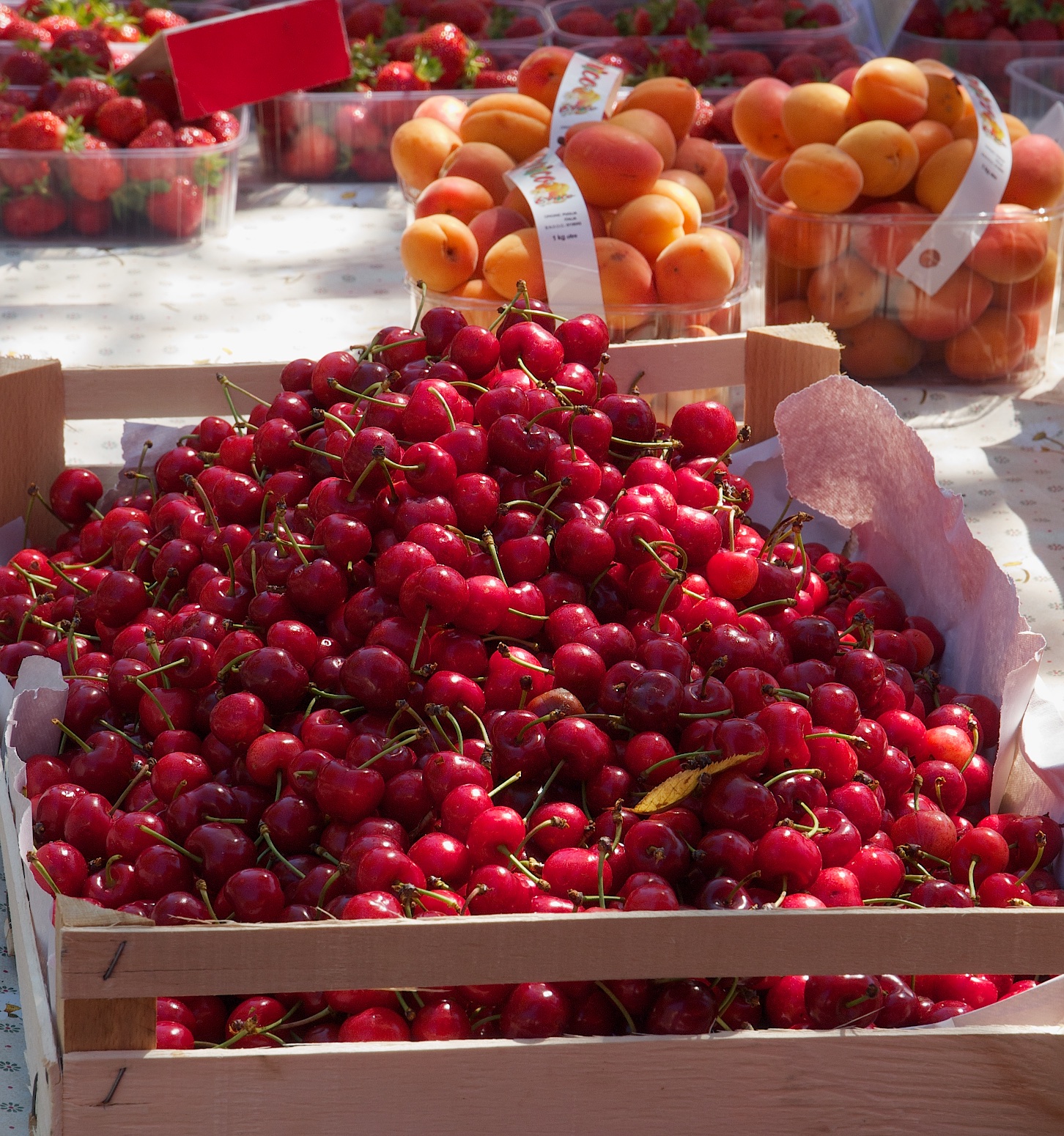
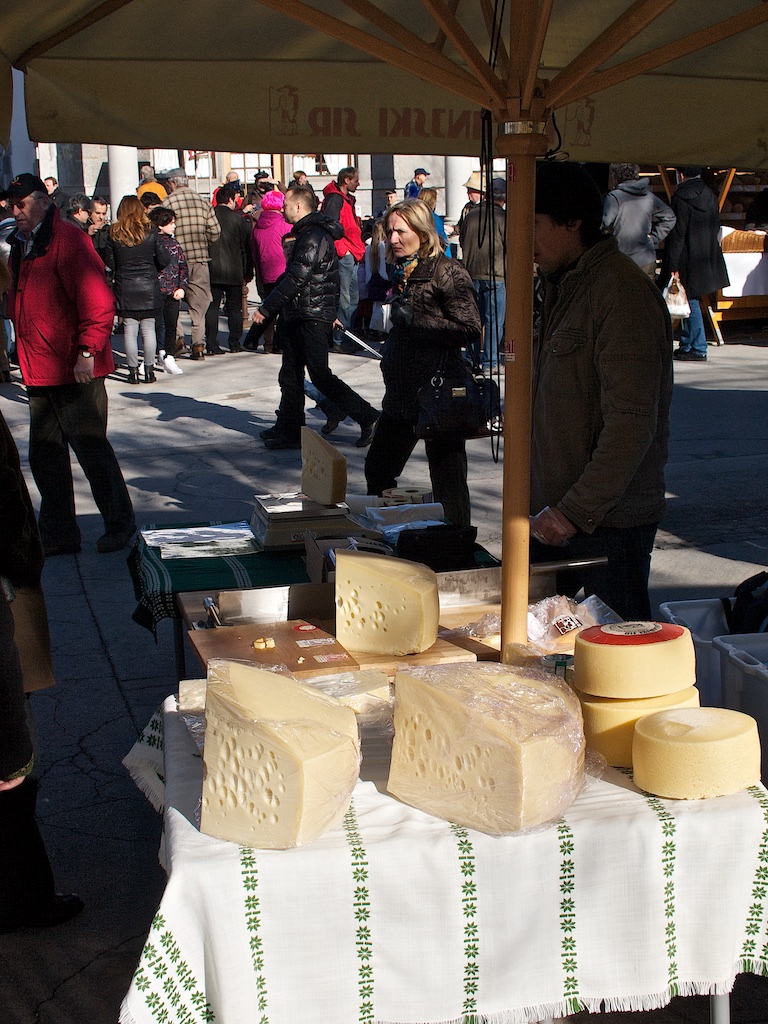
Among the great joys of a camera is wandering around a farmer's market shooting the food.  It looks so much better outdoors than in the sterility of an Acme or Stop and Shop.  I was always amazed in Ljubljana where there was an outdoor market six days a week almost year round (not on Sunday) that the vendors set up and broke down their stalls, including the wooden shelves etc, daily.  


+ Fr. Jack, SJ, MD