Saturday, July 29, 2023

Decisions, Decisions, Decisioins: Homily for the 17th Sunday in Ordinary Time


1 Kgs 3:5, 7-12

Ps 119: 57, 72, 76-77, 127-128, 129-130

Rom 8:28-30

Mt 13:44-52


We make most daily decisions without much effort: do I cross now or wait until that car passes?  orange or apple juice at breakfast? take a nap or exercise?  Other choices however, require  discernment, thought, and effort.  We have all made life changing choices and will do so in the future.  Among the most important of those choices was the choice for or against Jesus.


The first reading and gospel both involve life-changing choices.  God asked  Solomon what he desired, with “and I will give it to you” implied rather than stated 

Solomon was young, nothing more than a kid.  Despite that he did not ask for things most of us would want: a long life, a healthy life, riches, or a great car.  Solomon asked for understanding,  he asked for the wisdom to discern

between good and evil, and the ability to be a good leader.   His request pleased God. It was granted. 


One can only pray that our national leaders--BOTH parties--would ask God for the same.   Imagine congress praying for the wisdom to be good leaders

rather than offering human sacrifice on the altar of abortion, worshipping the perverse and sexually  bizarre. The pathetic assistant surgeon general who supports blocking a child’s puberty, is beneath contempt. 


Every choice involves a cost. Sometimes we realize what that cost will be.  Other times the cost comes as a surprise.  When we make a choice other options  are closed off.   Sure we can change our minds about orange vs. apple  juice, or even have both,  but the most important choices close off the other possibilities. 

Choosing to marry a particular man or woman, closes off the choices among all others. Choosing to enter religious life closes off the option to marry and have a family.


The three short gospel parables are about choices.  They are related but each has a unique message.  Unlike their usual response the apostles replied 'yes'

when Jesus asked if they understood. Repetition seems to have had an effect. 

They finally got it,  just as we get it and begin to understand what Jesus is telling us the more we listen to His word.


The first two parables recall an event in 1990. that blew the art world and the  Society of Jesus out of the water.  Dublin's Leeson Street Jesuit Community sent a painting that had been hanging in the dining room for more than sixty years to be cleaned. It was thought to have been a copy of a long-missing Carravagio called "The Taking of Christ."  But one of the art restorers noticed something.

It WAS the missing painting worth tens of millions of pounds.  It was both the treasure discovered accidentally in a field and the pearl of great price noticed by an expert.  It is now on permanent loan from the Society of Jesus to the National Gallery of Ireland.  Don’t miss seeing it if you’re in Dublin.


What about buried treasures? Most people today would ask why the treasure was buried in a field in the first place.


Matthew wrote his gospel when invasions were a regular threat.  One way to keep a treasure safe was to bury it in a field.  Of course before selling the field

it was important to remember first, that it was buried and second, where it was buried. Today we hear stories of very valuable objects found at flea markets, a kind of buried treasure equivalent,  and estate sales, particularly those of local eccentrics. Indeed, PBS’ Antiques Road Show is premised on this gospel passage.  


When the man realized what he had found buried he went away happy,

chose to sell everything he had, and purchased the field so as obtain the treasure.  When we realize the value of the Kingdom of Heaven, when we truly understand and commit ourselves to following Jesus, we too can go off happy,

knowing that we have found the most valuable treasure.  


The man’s discovery in the field was an accident.   Not so for the merchant.  He was an expert on a quest. He was looking for fine pearls and found an exceptional one.  The merchant realized, on the basis of his experience, knowledge, and sharpened attention to what he was doing, that this was the real thing.  He had found the pearl for which he was searching.  He too chose to act

and commit to a course of action so as to obtain it.


The merchant’s excitement mirrors that of the one who discovers Christ later in life or the one who, having been baptized into the church, rediscovers what he or she had given up during that spiritual chaos known as young adulthood, and returns to active observance.  


Both of these figures made irrevocable choices.  Neither could have repurchased what had been sold. Neither could ever go back to the time before he made the decision.  They had passed the point of no return. 


The final parable is a bit different. 


All of us can identify with fishing though few have experienced fishing with a drag net. A drag net picks up everything,  fish, plant life, and all kinds of inanimate objects.  After the net is hauled ashore the fishermen go through the contents,

keep the good fish discard those that are not good, and dispose of the detritus.

The parable recalls last week's gospel about the weeds and the wheat. When the field was harvested the weeds were thrown into the fire and the wheat stored in barns.


Good and evil, virtue and sin, have coexisted since the beginning of time, some things will never change.  Our dilemma is whether or not we choose to trust in the promises of Christ as described by Paul, “We know that by turning everything to their good God cooperates with all those who love him, with all those that he has called . . .”  


Accepting or refusing God’s grace is our free choice.  We can never be forced

to accept or cooperate with that grace. However, all other important choices in our lives depend on that decision. 


______________________________________________________

Photos from ten years ago in Ogunquit, Maine.  Only had 24 hours there visiting my sister and a friend who were vacationing there.  


Saw the blue door and geraniums and reached for the shutter.  Ogunquit is a very charming place though the traffic getting there in the summer is dreadful.

Kayaks for rent.  I did not even consider the possibility.

This photo triggered many memories even though I was never a lifeguard.  Mostly movie memories such as 'Summer of '42', 'Where the Boys Are',' and all the Annette "Beach Blanket Bingo" movies.

Black and white adds another character to it.

Processed to exhance the dark-light contrast.

This is a great photo.  I was able to erase someone walking into the water and focus only on the kid running barefoot on the beach with his.  This will be an indelible memory for both.

 Fr. Jack, SJ, MD

Sunday, July 23, 2023

Gettin' Old: Homily 3rd World Day for Grandparents and the Elderly

Gettin' Old:  Homily 3rd World Day for Grandparents and the Elderly

23 July 2023


On January 31, 2021, Pope Francis designated the Fourth Sunday of July

as the First World Day for Grandparents and the Elderly. Today is the third annual observance. It is a day on which to pray for the intention of those who are old, an opportunity to meditate on the great gift of wisdom, and a time to acknowledge the critical role played by elders throughout the world


It is not easy being old in the youth-crazed, old-age denying, and productivity obsessed U. S.  The same is apparently true in Australia about which Trappist Michael Casey writes: "Some societies reverence the old, seeing in them the embodiments of ancient wisdom and experience.  We, on the contrary, seem to hanker after illusory youthfulness, so quickly and irretrievably left behind." 

There are no valid arguments to counter this assessment.


Among the most insulting of comments directed at an old person is the ever popular and terribly hackneyed, "You're not 83 years Ollllld.  You're 83 years Youuuuuuuuuunnnnng."  A waiter said that to my then 85 year-old mom.  Can't quote her response in sacred space but I suspect the young man thought twice before saying it again.


Insisting that an octogenarian is young efficiently accomplishes two things. 

It strips the individual of his or her dignity and, more significantly, reveals the speaker's terror of aging, fear of death, lack of compassion, and general unkindness.  Nothing horrifies Americans more than the thought of aging, the idea of having to live within the physical, cognitive, and functional limits imposed by the aging process.


I used to envy pediatricians only one thing: they have age-linked charts and graphs to track a child's physical, psychological, and cognitive development. 

One quick checkmark and ya' got that covered. Next patient. All I had in geriatrics was  a blank piece of paper on which to record the uniqueness that defined the old man or woman sitting on the other side of the desk.


No checkmark or click of a computer mouse on an electronic record  can summarize an old patient's history; no average, below average, or above average designation can describe the nuances of his or her life be it in the medical clinic or psychiatry office.


We become increasingly different as we age.  Department stores group children's clothing by age:  birth to six months, six to twelve months, one to two years, and so on.  Even though I keep looking, I've yet to see a clothes rack for 65 to 75 years old standing next to one for 60 to 65 year-olds. 


Some do have an easier time with aging than others.  No matter what however, we must not deny the reality of the old by insisting they are really young despite all evidence to the contrary.


If we are to truly honor and respect the elderly we must accept each individual

for who, what, and how he or she really is, rather than demanding they be

who, what, and how we want them to be which is young.


Stanley Hauerwas writes in his book Growing Old in Christ, "one of the problems of our time is the assumption that we can and should live as if we will never grow old." It is an important observation. In chapter twelve Job asks, “Is not wisdom found among the aged?  Does not long life bring understanding?”  Denying the reality of aging is a refusal to acknowledge and respect the wisdom of the old. 


Remember the motto of the late 60s  “Never trust anyone over thirty?” Ironically, those who marched while chanting that slogan are now septuagenarians, if they lived long enough.


Wisdom is neither innate nor genetic. It is acquired through long experience

of success and failure. It is acquired most easily by those with a listening heart, and the courage to enter into silence and prayer so as to reflect on their lives with awareness that those lives are nearing an end.


Wisdom is a force in the world that is critical to civilization, fundamental to being human, and the most significant factor separating us from all lower animals.  It also separates us from “artificial intelligence” a concept that is artificial but nothing more.   


When others insist that an old man or an old woman is YOUUUUUUUUNG

they are denying his or her existence, disparaging the challenges he or she has faced, and throwing in a complimentary dollop of hostility.


For many years JAMA, the Journal of the American Medical Association,  featured cover art with commentary by M. Therese Southgate, a physician

who was a self-taught art historian. Some weeks her essay was the best thing in the issue.


The May 3,1995 cover was a painting by Henri Amiel who Southgate quoted in her essay.


"To know how to grow old is the masterwork of wisdom

and one of the most difficult chapters in the great art of living."


Others have also reflected on aging. Bette Davis was more droll than Amiel in her pithy statement: "Old age ain't for sissies"


In his homily on the Feast of the Presentation some time in the early 1990s,

Jesuit Father Jim Casciotti said, "Old age can be a time of bitterness and regret, clinging to the past, and resenting any changes or loss of independence.  But, to those whose faith has deepened with the years

there comes wisdom, integrity, and a sense of providence."


As this annual day for the elderly becomes established in the calendar, I hope liturgists have the sense to include somewhere in the liturgy Habakkuk's great psalm for the elderly who gradually lose much. 


"For though the fig tree blossom not

nor fruit be on the vines,

though the yield of the olive fail

and the terraces produce no nourishment,

though the flocks disappear from the fold

and there be no herd in the stalls,

Yet will I rejoice in the Lord

and exult in my saving God.

God, my Lord, is my strength;

he makes my feet swift as those of hinds

and enables me to go upon the heights

________________________________________________________


 Hope this works.  Google completely screwed up my blog access.  Some kind help from someone on the computer helped to restore things but the work space does not look the same was as it did for the past eleven years. 


Will try to add a few photos and see what happens.   All of the shots are from Longwood Gardens where I first became interested in photography thanks to a med school classmate who is a very talented photographer.    These need no explanation simply that they are pretty.  Haven't been down in that direction in a number of years but if and when I do, off we go. 


Fr. Jack, SJ, MD

Sunday, June 18, 2023

I Did Not Sign Up for This: Homily for the 11th Sunday in Ordinary Time

 Matthew 9:36-10:8 

Jesus sent His apostles on mission with power over unclean spirits and the mandate to ‘cure every disease and every illness.’  It is a powerful mandate that includes an important distinction.  While giving the apostle the instruction to cure disease AND illness might strike some as redundant, the distinction is important to understanding the mission of the Church. Disease and illness are not the same thing or synonymous. Few are able to cure disease all have the mandate to treat illness. 


Disease is a biomedical affliction with pathological changes in an organ or organ system at the macroscopic, microscopic, or submicroscopic levels.  A disease affects only the patient. The illness, on the other hand, is a sociocultural perspective that includes how the individual and others perceive and experience certain states that are disvalued or feared, states caused by disease. Illness affects not only the individual but the family, the community, and at times all of society, in ever widening circles.  


The historical dichotomy is apparent in scripture if we consider leprosy.  Leprosy as described in both Old and New Testaments never had anything to do with what is now known as Hansen’s disease.  Leprosy was a catch-all term for visible lesions including vitiligo, psoriasis, and other scaly blemishes. Jesus cured the disease but more significantly He cured the illness and returned the sufferers to themselves and to society.  There are modern illustrations of the difference between disease and illness


AIDS was first described in June 1981.  By 1990 almost 101,000 had died of AIDS in the U.S. with 1/3 of those deaths reported in 1990. The toll of the illness on family, friends, community, and society was, is, and will remain beyond accounting. Ironically, one of the centers of medical care in the first decade of AIDS was St. Vincent’s Hospital in New York’s Greenwich Village, a hospital built and founded by the Daughter’s of Charity. It is ironic because the congregation’s old habit, with its distinctive coronet, is now being blasphemously mocked by the evil spirits infecting a pathetic group of men in Los  Angeles, a group whose name is beneath the dignity of repeating.  It is a blasphemy supported by the Dodgers baseball organization.  How soon they forget the deeds of the courageous women religious of all orders and congregations throughout history.


We had a refresher course in the difference between disease and illness thanks to covid which, as of 31 May 2023, caused one hundred three and a half million cases  and one million one hundred twenty seven thousand deaths in the U.S.  Of those deaths almost 853,000, fully three quarters of the total, were in the elderly sixty-five and above.  Many of those elderly, as well as patients hospitalized for other reasons such as broken hips,  were forced to suffer and die in anguished solitude, perceiving abandonment by their families and friends and bereft of the sacraments through a combination of government fiat, irrational fears of hospital and nursing home administrators, lack of compassion, and generalized stupidity.  As with AIDS the impact of covid can never be estimated.  The suffering caused by the illnesses associated with both diseases will reverberate for decades.  


How did the twelve apostles perceive Jesus’ mandate to cure disease and illness?  How did they feel when it was given to them?  How did they feel when the going got rough or when they realized the risks?  Ideally they did not respond in the same way as a young physician who wrote an op-ed column in response to covid titled, “I Didn’t Sign Up For This,” an extended whine about having to work under the conditions and risks of covid.  It might be best for this young doc to hang up the stethoscope now and seek a different line of work.


Mandate derives from the Latin mandatum, itself composed of two roots: manus (hand) and dare (to put) meaning ‘to put into one’s hands.’  The foot washing of Holy Thursday is referred to as the mandatum from Jesus’ words at the Last Supper  “I have given you an example, so that as I have done for you, you should also do.”


The histories of AIDS and covid as diseases AND illnesses have a shameful element in common.  That shame was, and is, the refusal of too many with training and ability to treat patients because of the diagnosis.  The stories of refusing to allow patients with AIDS to even enter a medical office were many during the early years.  More recently Arthur Caplan, a medical ethicist in New York published a column on Medscape titled, “It’s Okay for Docs to Refuse to Treat Unvaccinated Patients.”  The good news is that Caplan is not a physician. He cannot treat patients.  The over 700 responses to his column were overwhelmingly negative, angry, or both.  It is never OK to cherry pick who or what will be treated based on diagnosis or social opinion.  I suspect had Caplan written that it was OK to refuse puberty blockers for so-called transexual children he would have been fired right quick.  


It is not easy to treat diseases.  Sometimes the best we can do is keep it at bay for a little while.  Treating the illnesses of modern times is even more difficult. That is a separate homily.  But, we have all been given the same mandate as that given to the apostles.  That is to treat illnesses and proclaim the Kingdom of Heaven through our words and the example of our lives.  


______________________________________________

The photos below are from the Church of St. Martin d'Ainay in Lyon, France.  Alas, I was not told about this gem until very late in my stay there.  I think its 11th century.  I would have shot more but there was a liturgy of some sort, possibly a baptism, happening and I did not want to intrude.  


A small stained glass window.

The main altar.  I was blown away by the fresco on the ceiling and the gold leaf. 
The play of light and shadow drove this shot. 
The baptistry.  We rarely see that kind of ironwork today. 

 Fr. Jack, SJ, MD

Sunday, June 11, 2023

Panis Angelicus_Homily for the Feast of Corpus Christi

 Dt 8:2-3, 14b-16a

Ps 147 

1 Cor 10:16-17

Jn 6:51-58


The Feast of the Body and Blood of Christ, also known as Corpus Christi, is always a happy personal anniversary.  I celebrated my first Mass on the Feast of Corpus Christi in 2007, twenty-four hours after being ordained.  The feast signals 

another cycle through the missal and lectionary. Thus, today marks either the completion of the sixteenth time through the books or the beginning of the seventeenth exploration of the same books of prayer, ritual, and readings. 


The Church’s calendar is filled with feasts: The Annunciation, Christmas, Easter, and Pentecost to name a few.  These feasts recall specific events in the history of salvation the history of the world, and specific moments in own personal histories.  They underlie the rhythm for our lives.  


Most of the feasts have a narrative flow.  There is a story in the readings that is retold annually.  Every year we hear the narrative of Jesus’ birth,  the long readings of the passion, and the reports of the descent of the Holy Spirit.  We can insert ourselves into the action on the page,  we can place ourselves at the manger in Bethlehem imagining the sights, the sounds, the aromas, and our own response to the event.  We can be present at Mary’s visitation to Elizabeth, fall asleep with the apostles in Gethsemane, or share in the shock of the newly empty tomb.  


Today’s feast is different. We have to sit back in silence.  There is no narrative or script.  The readings elaborate on the feast   by inviting us into quiet contemplation of the greatest of gifts, that of the Body and Blood of Christ truly and substantially present in the Eucharist.  It is overwhelming to consider 

that presence in the elements consecrated on the altar and received at communion.  It is deeply consoling to kneel in front of that same presence

in the tabernacle at all times whenever we wish. Alas, for some Christ’s real presence in the Eucharist is a stumbling block.  They can understand symbols.  They can understand metaphors. Some can even understand allusion. But still cannot understand real.  


Each of today’s readings adds something to our understanding of the meaning of this feast. 


In Deuteronomy Moses recalls what God had done for the Israelites in the desert.  

Once more he reminds them how God cared for them: bringing forth water from the rock and feeding them with manna, the bread from heaven, that prefigured the Bread of Life come down from heaven.  Moses reminds those he is leading,

“Not by bread alone does one live, but by every word that comes forth from the mouth of the LORD.”  


This pushes us towards the Gospel.  


In his commentary on John’s Gospel, the late Jesuit Father Stanly Marrow wrote on the passage we just heard: 


 “. . . there is only one way of proclaiming the salvation in Jesus Christ, and that is by means of the Word.  The sacraments are another mode of proclamation by means of this same word.”  Recall that the first verse of Johns gospel proclaims: “In the beginning was the Word and the Word was with God and the Word was God.”


We need the Living Word.  We need the Living Word that is present  in the Eucharist and scripture,  We need the living word of  tradition and of prayer.

We need the Living Word if we are to know eternal life.   


Later in his commentary Fr. Marrow points out a crucial fact:  

“The promise of living forever in no way exempts any of us from dying.”


Today’s gospel began with Jesus telling the crowd: “I am the living bread that came down from heaven: Whoever eats this bread will live forever.”  At the end He reiterated.  “This is the bread that came down from heaven.  Unlike your ancestors who ate and still died, Whoever eats this bread will live forever.”


In no way is Jesus promising that our lives will be free from pain and suffering.  Jesus is not promising nor did He ever promise,that we and those whom we love won’t die.  Without dying none of us could hope to rise again at the last day. Eternal life is only possible through the Living Word; through Jesus the Son of God.  


The translation of the last verse of Paul’s First Letter to the Corinthians is awkward.  Loaf is not only unnecessary, it wrecks the flow of the sentence. .  

Another translation reads: “Because there is one bread, we who are many are one body, for we all partake of the one bread.”


“We who are many are one body for we all partake of the one bread.” 


We are one when we are gathered here to listen to the Word of God, when we receive that Living Word at communion. and when we leave here to go about our daily lives.  We remain one after death.  


Today we recall the great gift of The Body and Blood of Christ.  

Real.  Substantial.  Truly present in our midst.  With that in mind we can only sit in awe and say with the psalmist: 


Praise the Lord Jerusalem. 

Alleluia.  

Amen.  

_________________________________________

A few shots from Sevenhill, South Australia, one thousand acres of heaven on earth. 


I was not the only photographer in the group.  John The was very good. 

Sevenhill is a winery with a farm attached.  One of the farm denizens. 

Many of the mornings was wonderfully misty.

Looking up from a road way below the subject. 

Fr. Jack SJ, MD


Saturday, June 3, 2023

Homily for the Solemnity of the Holy Trinity

 The Solemnity of the Most Holy Trinity compels us to contemplate the essential dogma and foundation of our faith. 


We begin and end the Mass with the Trinitarian formula.  The doxology of Glory be to the Father, and to the Son, and to the Holy Spirit, is chanted with particular reverence by monastic communities after every psalm and canticle during the liturgy of the hours.  We recall the Trinity every time we bless ourselves.


What we call the Trinitarian formula, in the name of the Father, and of the Son, and of the Holy Spirit  cannot be replaced by neutered  gender-free versions such as in the name of a creator, a redeemer, and a sanctifier or other absurdities. A person is not a function. No function defines an individual. The dogma of the Holy Trinity is One God in Three Divine Persons, not one object with three functions.  The Trinitarian formula is critical to the Church's seven sacraments, 


The sign of the cross begins and ends everything the Church does. As it should and as it must.  We read in The Catechism of the Catholic Church, (#234):  “The mystery of the Most Holy Trinity is the central mystery of Christian faith and life. It is the mystery of God in Himself.  It is therefore the source of all the other mysteries of faith, the light that enlightens them. It is the most fundamental and essential teaching in the hierarchy of the truths of faith.”


Every time we make the sign of the cross we recall the mystery of the Trinity, a mystery that remains incomprehensible  despite the many books attempting to explain it.  Each book may contain a fragment of insight but the sum of all the books written does not come close to capturing the true essence of the Trinity.  The dogma of the Trinity can only be understood through faith. This raises the question, What is faith? 


A dictionary defines faith as:  “Belief that does not rest on logical proof 

or material evidence.”  The  Letter to the Hebrews defines faith in forty verses that make up the entirety of chapter eleven. It begins with: "Faith is the realization of what is hoped for and evidence of things not seen. . . . By faith we understand that the universe was ordered by the word of God, 

so that what is visible came into being through the invisible." 


Faith is mysterious and impenetrable. There is no chance of truly "explaining" the Trinity. But no one can declare him or herself a Christian if he or she denies the Trinity.


The word Trinity does not appear in scripture.  The understanding of the Trinity grew in the earliest years of the Church as she began to consider 

what Jesus said and did during His time on earth.   


Jesus always spoke of the Father as distinct from Himself while also saying, 

“I and the Father are One.”  The same is true of the Holy Spirit.  When Jesus refers to His oneness with the Father he is referring to substance and NOT the functions of creation, redemption, and sanctification. Thus, the ancient creeds in Greek use homoousion which was translated as consubstantialem  in Latin. It is obvious that the English consubstantial, a word we will pronounce in a few moments during the Nicene Creed, arises directly from the Latin. The Trinity is a mystery. It will never be anything other than mystery. 


The responsorial prayer   came from the Book of Deuteronomy rather than the psalter.  It is a doxology to the Father:  "Blessed are you, O Lord, the God of our fathers, praiseworthy and exalted above all forever;  And blessed is your holy and glorious name, praiseworthy and exalted above all for all ages."


And thus the doxological praise of the Trinity that echoes it. Glory be to the Father, and to the Son, and to the Holy Spirit. As it was in the beginning, is now, and ever shall be, world without end.  Amen.

________________________________________


The photos are from Warrnambool, Victoria, Australia.  Spent three weeks there giving retreats in daily life and walking to the beach whenever possible.  


The kind of detail I always look for.  There is at least a short story in this scene if not a semi-morose pop song say by Cat Stevens.


Fr. Jack. SJ, MD

Tuesday, May 30, 2023

My Soul Proclaims the Greatness of the Lord: Homily for the Feast of the Visitatioin

Lk 1:39-56


Mary’s Visitation to Elizabeth makes the entire gospel more human.  It is the sort of event that could, and does, occur in any of our lives.  Reading between the lines fleshes out the story’s humanity. 


Upon learning that she was to be the Mother of Jesus, Mary went to visit her relative Elizabeth who was in her sixth month of pregnancy.  Kinship was understood differently in the Ancient Near East than it is today, thus, we will never know how Mary and Elizabeth were related.


Mary did not have an easy time traveling no matter how sentimental painted images are.  It was about 80 miles from Nazareth to Elizabeth's house in Hebron 

as the crow flies.  It was closer to 100 miles when following established routes.

To get an idea of the distance, walk out of the driveway here, make a right and stop in Hartford, CT.


Someone traveling unencumbered on foot could cover about 20 miles a day.  Thus, Mary's journey to visit Elizabeth would have taken a minimum of five to seven days. But, given that the dangers of being on the road were as risky then as they are today. she would have traveled with a caravan rather than alone.

The trek could have taken much longer than seven days. 


But eventually there they were,  two women, one older than the other.  What did they talk about? Did Mary stay until John's birth as pious legend holds or did she leave before John’s birth?  What did Mary think about on her return trip to Nazareth, a trip that was no shorter than the one from Nazareth to Elizabeth’s home. And Mary was now three months pregnant. 


Mary's prayer in response to Elizabeth’s greeting, known as the Magnificat, is recited every evening at vespers.  Over the centuries it has been set to music by many composers.


"Magnificat anima meo Dominum

Et exsultavit spiritus meus 

in Deo salutaris meo."


"My soul proclaims the greatness of the Lord, 

my spirit rejoices in God my savior."  


Certain lilies that must never be gilded. Mary's Magnificat is one of them.  The prayer speaks of quiet contemplation and profound understanding of God's will. 

It is meant for the solitude of our souls and the silence of our hearts.  It does not require academic debate, acrimonious argument, or a gender-neutral feminist translation.  The Magnificat requires nothing but daily repetition and frequent meditation. 


Mary and Elizabeth demonstrate fidelity even when things don't seem to  fit together.  They are examples fidelity despite dramatic and unexpected life changes.  They are models for those who find themselves in places and situations they never expected. 


Reread the Magnificat  later today.  Spend some time sitting with these two women. Watch them go about their tasks.  Listen to their conversation.

Pay attention to their silences as they sat in each other’s presence. 


" . . . the Lord has done great things for me."


The Lord has done great things for all of us. 

_________________________________________________


The Visitation is one of my favorite Marian feasts,, one nof the reasons being the gospel.  Sometimes I am sorely tempted to recited the Magnificat from memory.  But I also know better.  


The photos are from one of the many nighttime walks I took in the city as late as 1 AM and as early as 5 AM.  Total safety. 


Fr. Jack, SJ, MD

Sunday, May 28, 2023

Pentecost Sunday

 Acts 2:1-11

Ps 104

1 Cor 12:3-7,12-13

Jn 20:19-23


The word Pentecost derives from Greek meaning fiftieth day. The term is not unique to the Church as today’s solemnity is historically, symbolically, and, as it ended at sunset yesterday, calendrically linked to the Jewish celebration of Pentecost, also known as Shavuot


Shavuot commemorates God's giving the Torah to Moses on Mt. Sinai fifty days after the Exodus.  It falls fifty days after the first seder of Passover, always falling  between May 15th and June 14th.  In the Catholic liturgical year Pentecost is celebrated on the fiftieth day after the Resurrection of the Lord, no earlier than May 10th or later than June 13th Just as Moses received the wisdom and teaching of the Torah fifty days after the Exodus, the Church received the wisdom and

teaching of the Holy Spirit on the fiftieth day after Jesus’ exodus from death. The first reading is dramatic. Wind.  Fire.  Speaking in tongues.  An ideal scene for a Cecil B. DeMille movie.  The people were shocked when they heard the unsophisticated Galileans speaking whatever language necessary to tell the city's many visitors the Good News of Jesus.  


The speaking in tongues is sometimes referred to as “the reversal of Babel,” the undoing of the event that caused the earth's multiplicity of languages, a symbol of disunity.  At Pentecost, that which had been split apart by human pride at Babel

was reunited through Jesus’ obedience to the Father.  That which had been shattered by hubris, was reassembled by Jesus, who sent the Holy Spirit as He had promised.  As Paul wrote to the Corinthians, “To each individual the manifestation of the Spirit is given for some benefit.”  He listed some of those gifts in his Letter to the Romans. Today we celebrate the giving of those gifts.  Each of us receives unique gifts that are not identical with those given to another. Our task is to discover and develop our unique gifts throughout life.  


In some parts of U.S. society it is fashionable, indeed it is a form of virtue signaling and wokeness, to deny even the possibility-- to say nothing of the reality--of differences and distinctions, of abilities and inabilities, of truth and u truth.  This bizarre thinking has now affected medicine.  The price will be high indeed. The risk of not hewing to, teaching, or preaching the narratives du jour

may result in job loss, demands for public mea culpas, or cancellation, the American version of Solzhenitsyn’s Gulag.  Perhaps the stocks will be resurrected on Cambridge Common to punish those who disagree with gender ideology. Many choose to deny fundamental biological differences 

with a delusional intensity.  Apparently the mantra “follow the science” 

is acceptable only under certain conditions but optional under others. 


Denying differences fuels a heightened sense of specialness in which each individual or faction insists that his, her, or the group's specialness must be recognized as the most special of all forms of specialness, even to having a day, week, or month dedicated to trumpeting that specialness.


One of my physiology professors at Penn State shared a parody about the body in which the general outline was an argument among organs and body parts as to which was the most important,  which was the supreme controller, which was the MOST critical to the body’s function, its comfort, and its ultimate survival.

It was long, hilarious, and cannot be repeated in sacred space. However, the main point was that there is no most important organ. All of the body's organs and organ systems are equally necessary to life.  Each has unique functions 

that cannot be replaced or substituted by another.  The lungs cannot do the work of the liver,  the liver cannot do the work of the heart,  and the pancreas definitely cannot cover for the kidneys.  


One of the most dangerous lies ever is: "You can be anything you want to be." 

No one can become anything he or she wants to be simply by wanting to be that thing, or, in current terminology, by self-identifying as it.  All of us have certain immutable limits determined by chromosomal and genetic makeup, anatomy, and physiology neural development and many other factors and inherent talents. 


Strengths are balanced by weaknesses.  Native abilities are enhanced by inabilities,  Potential in some areas is balanced by a complete lack of same in others. The only equality among humans is that all are sinners loved by God. 


Comparing the account of Pentecost in Acts and the account of the Holy Spirit’s descent as narrated in John's Gospel may be confusing. "When the time for Pentecost was fulfilled, they were all in one place together." The descent of the Holy Spirit in Acts was clearly fifty days after Jesus' resurrection.


"And when he had said this, he breathed on them and said to them,  "Receive the Holy Spirit."  John's Gospel seems to indicate that the disciples received the Holy Spirit soon after the Resurrection while Jesus was present among them.


How does one reconcile the two accounts?  There is no need to do so. 


Yesterday's gospel ended with the final verse of John's Gospel, indeed with the final verse of the Book of the Gospels:  "There are also many other things that Jesus did, but if these were to be described individually, I do not think the whole world would contain the books that would be written."


We cannot and must not isolate discrete moments or episodes from what is one integral event, the event of Jesus' revelation of the Father. As the late Jesuit Father Stanley Marrow explained, "He who dies on the cross, is he who rises from the dead, returns to the Father who sent him, and sends his Holy Spirit on all who confess him as Lord and Son of God.”  There is no discontinuity.


The gifts and graces of the Holy Spirit have been bestowed on us. That is all we need to know. The logistics and pneumatology are unimportant.  Our task is to cooperate with those gifts and graces in the manner to which each of us is called. Our mandate is to share the news of Jesus with those whom we meet in whatever language necessary.


____________________________

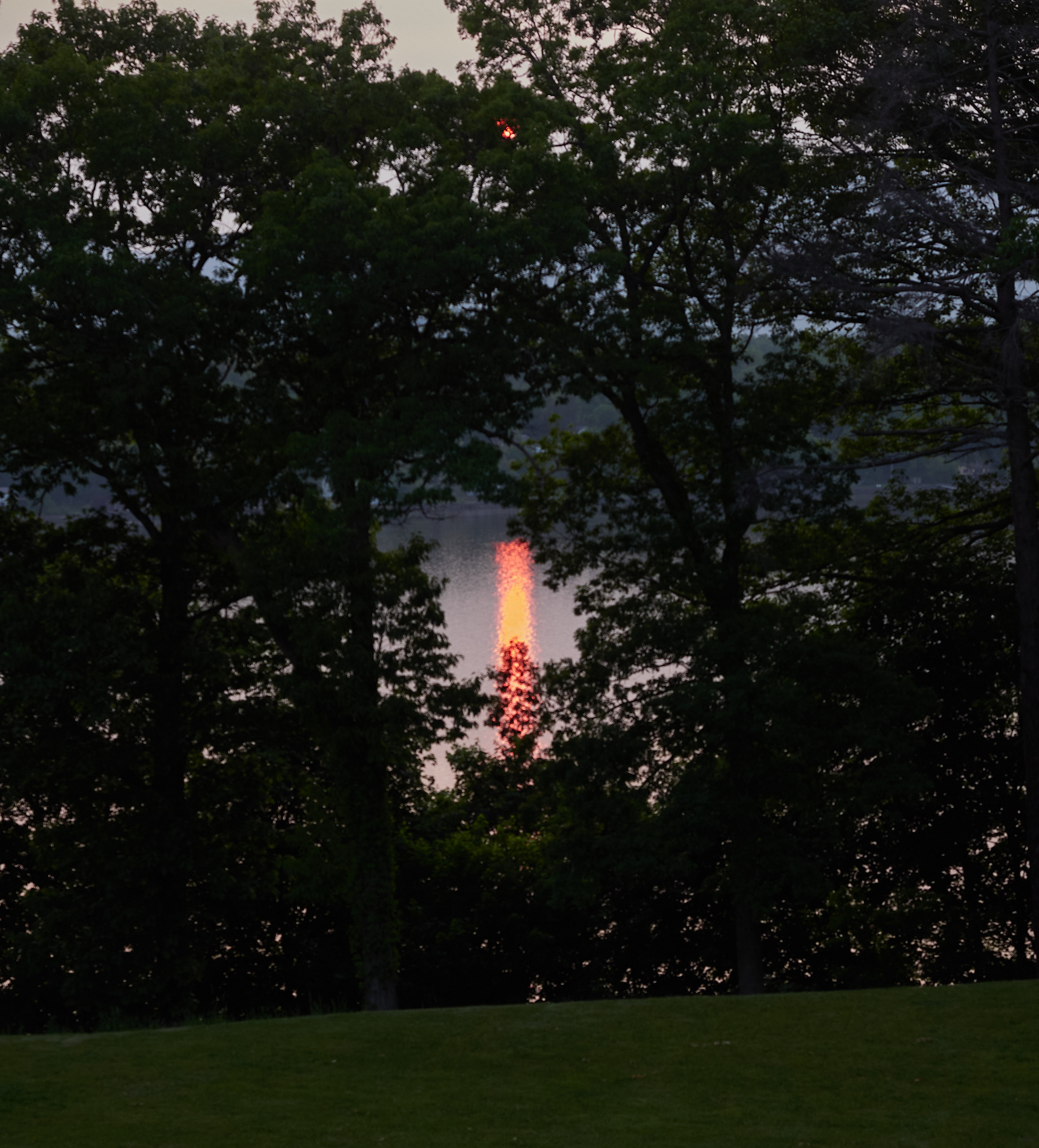
Got a late start at posting.  Spent all of last week until mid-morning yesterday in Germantown NY giving a retreat to the Carmelite Sisters for the Aged and Infirm at their motherhouse.  The house is in an exquisite setting on the banks of the Hudson River overlooking the Catskills.  Had hoped to do more shooting but the trees were so lush that there wasn't much in the way of a view of the mountains.  Below are a few that I did get.  


Sunset reflected in the Hudson.  This was view from my room.

Taken a few moments after the one above as the sun went below the Catskills

Crucifix and tabernale

A little tricky to open. 

My quarters were attached to this house.  The sisters have significant acreage. 

Koi in the duck pond

Ducks in the duck pond. 

Fr. Jack, SJ, MD