Sunday, April 10, 2016

3rd Sunday of Easter

Acts 5:27-32, 40b-41
Ps 30
Rev 5:11-14
Jn 21:1-19

“But Peter and the apostles said in reply . . . .
‘We must obey God rather than men . . . .
So they left the presence of the Sanhedrin,
rejoicing that they had been found worthy
to suffer dishonor for the sake of the name.’”

Is this the same Peter who denied Jesus three times?  Is this the same man whose incomprehension provoked Jesus to say, “Get behind me satan?”  Peter, who swore he did not know Jesus is now proclaiming that Jesus is risen from the dead, that He is the one of whom David spoke.  Fearful of being known as one of Jesus’ disciples while huddled around a fire Peter is now preaching what was blasphemy:  That Jesus had risen from the dead. That He is the Messiah. That He is the One of whom David spoke.  These are the same apostles commentators love to slag because they were not clustered around the foot of the cross.  Now they are willing to face death for the sake of His name.

Lent is always open season on the apostles. The critiques, are generally amusing, particularly if one pays attention to the underlying current of heroic narcissistic self-aggrandizement that implies:
I never would have denied Jesus. 
I never would have fled from Calvary. 
I never would have behaved as Peter, Thomas or . . . .(fill in blank) did. 
Yeah right.  And Elvis is still in the building.  To paraphrase the late Walt Kelly's comic strip Pogo:  “We have met the Apostles and they is us.”  Flawed.  Clueless.  Imperfect.  In a word,  human.  “We have met the Apostles and they is us.” Capable of great kindness.  Compassion.  Heroism.  And love.  In a word,  human. 

We have, and will, turn and run in the past.  We will do it again.  We all  misunderstand until we receive the Holy Spirit.  And even then we manage to misunderstand on occasion.  Remember, Peter and the apostles received the Holy Spirit at Pentecost.  No longer fearful, no longer uncomprehending, they are fundamentally changed.  We would do well to recall that before curling the lip and dropping a bit of sarcasm in their direction.  

The behavior of the apostles in front of the Sanhedrin as described in the first reading contrasts with the Gospel. John reminds us that during the immediate post-resurrection period the apostles remained more or less uncomprehending.  They had returned to their boats and had gone back to that which was familiar.  When Jesus appeared to them after His resurrection they did not recognize him.  This particular Gospel reading can be broken down into several different homily topics. 

The catch of fish that ended with Jesus sharing a meal with the disciples.  This was a way to prove he was bodily present.  A spirit or a ghost does not need food and cannot take it in. 

The mission to Peter and, by extension, the other apostles and to us,  feed my lambs; tend my sheep, feed my sheep.  It requires no great mental gymnastics to see how this triple question undoes Peter’s denial of Jesus.  The mandate to tend to others and feed them with the Word of God persists two millennia later.   We can never forget that. 

And finally the prophecy of the future:
“When you were younger,
you used to dress yourself . . . .
But when you grow old . . .
someone else will dress you . . .”

What did Peter feel when he heard these words?  What did he feel when he heard “by what kind of death he would glorify God?"  What do we feel when we hear these same words?  Words that, for the majority of us, portend the kind of deaths by which we too will glorify God.  Those death won’t be through crucifixion in the concrete sense of the term.  Rather, for most of us, our deaths will be through the slow suffering and prolonged crucifixion of aging. That death will come from a collection of illnesses, acute, sub-acute, and chronic that will slow us down and rob us of our freedom and self-determination.

Will we be able to endure the dependence of aging?
Will we gracefully allow others to help us? 
Will we permit them to dress us? 
Will we cooperate when they guide us? 
Will we be grateful when they drive us because we are no longer safe behind the wheel? 

This evening return to the psalm:

“Hear, O Lord, and have pity on me;
O Lord, be my helper.
You changed my mourning into dancing;
O Lord, my God, forever will I give you thanks.”


These words summarize the readings.  They point us to the future. 
__________________________________________________________________

One of the men commented at dinner that is almost unreal that we are already at the third Sunday of Easter.  I noted that it was only yesterday when I got the last of the ashes from under my thumbnail and he were are, in the Easter Season.  Time does fly. 

The attached photos were taken in Ljubljana the last Saturday I was there.  About three inches of wet snow had fallen overnight and the day began gloriously sunny.  I left the community at about 9 AM with camera.  By 10:30 the fog and mist began to descend.  

Fog is the perfect filter when taking photos.  It softens the light, obscures detail in a dreamy way.  Taking photos in fog is a gift to the photographer.  

Tivoli Park and Castle is not too far from the community.  It is near the American Embassy.  It is a very large green space.  The castle looks more like a mansion, particularly in comparison to Ljubljana Castle that looks, well, like a castle. There is a long cindered pathway leading to the castle.  The day I was there the access points were blocked.  Along the path was a very large exhibit of photos of various architectural landmarks and features of buildings in Ljubljana.  I spent a long time looking at those and getting ideas. 


The photos were mounted on wedge-shaped easels.  There was a different photo on the obverse side.  The quality was superb. 
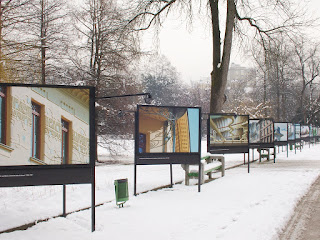
By the time I took this the fog has descended.  This photo was taken as I was leaving the park.  It was not yet noon. 

Finally, Ljubljana Castle on the way back to the community for lunch, the main meal of the day and not to be missed.  Now this is how a castle should look.  And it should be spooky. 

+ Fr Jack, SJ, MD

Friday, April 8, 2016

2nd Thursday of Easter

Acts 5:27-33
Ps34
Jn 3:31-36

". . . but whoever disobeys the Son
will not see life,
but the wrath of God
remains upon him."

"the wrath of God"

I suspect a number of us here, when asked how we felt in the midst of a severe cold, or the throes of a nasty hangover, or after flying for 24 hours have responded, "like the wrath of God."  Unfortunately, in the cavalier use of the statement, "the wrath of God" we see the multiple problems associated with translation combined with the evolution of language  and use of language.  What is the wrath of God?  Perhaps it is better to begin with the question what isn't the wrath of God? 

It isn't that strength-sapping diffuse muscle soreness that accompanies the flu.  Nor is it the screaming pain in your chest upon awakening from bypass surgery.  Alas, because of the frequent colloquial use of the term, we must be certain that we don't understand the wrath of God as the spiteful anger of a vindictive God.  That we don't envision a God who withholds His love while hurling thunderbolts of punishment aimed specifically at us.

Jesuit Father Stanley Marrow noted that "the wrath of God is the judgment that is consequent upon the rejection of God's love."  It sounds as if one could argue or a vindictive God but then Father Marrow goes on to elaborate. 

"A gift, even a divine gift, is not a gift unless it is freely accepted.  If the gift is eternal life, rejecting it can only mean death.  The rejection of the free gift is a judgment."  It is important to remember that the rejection of God's gift, the rejection of God, is our choice.  It is this rejection that Scripture calls the wrath of God.  Fr. Marrow makes a startling observation. Even God stands helpless before rejection by a creature he created to be free.  Our rejection of God's gift of life makes the Creator of All Life helpless. 

The wrath of God is not an angry punishment directed at us for misbehaving.  Rather, the wrath of God is the punishment we direct at ourselves when we reject the gift of eternal life in favor of the culture of death. 

 ___________________________________________________________________

It is turning into an odd April.  Torrential rain yesterday.  Snow the two days before.  Relatively nice today though a bit chilly.   Temperatures quite cool.  Glad I'm not a magnolia blossom. 

Rain, fog, and mist, conditions we've had here for the past several days make interesting settings in which to photograph.  Am looking to get some sort of rain sleeve for the camera.  I've tried the plastic bag route and have been neither happy with the awkwardness nor secure in the degree of protection.  I'm not certain the perfect weather sleeve has been invented.  Alas. 

My last weekend in Ljubljana was marked by chaotic weather conditions.  There was some snow on the drive in from Maribor on Friday.  It was raining when we got to Ljubljana.  The rain changed to snow overnight on Friday.  Saturday dawned spectacularly sunny with a few inches of snow on the ground.  Within ninety minutes of my departing the community with camera in hand the sky clouded up, fog began to descend and, as I was just returning to the house, a fine drizzle began.  By Sunday AM that drizzle had turned into a downpour.  such is the weather there.  The following photos represent the end of a three-hour expedition in central Ljubljana with the fog serving as a natural light filter.  

Tivoli Park and Castle is a pleasant walk from the community.  It is very close to the American Embassy.  All the paths to the castle were closed off.  Would like to get some photos from the front looking down on the path that serves as the main entry. 

The long view.  There was an exhibit of architectural photographs of various places in Ljubljana.  I spent quite a bit of time looking at it.  Beautifully done.


A cropped photo of the castle taken from a slightly raised vantage point.  The castle is highlighted by one of the last rays of sun to appear during the day.  The mountain behind was almost completely obscured by fog.

A few of the photographs  on display.  

The view looking back toward the city center.  I took these photos some time before noon.  The fog was filtering out most of the sunlight. 

Ljubljana Castle overlooks the city.  It looks more like a classic castle.  It was part of the view from my room.  This is the very center of Ljubljana. 

A Blessed Easter Season

+Fr. Jack, SJ, MD

Tuesday, March 29, 2016

Triduum 2016

Good Friday 2016  
The Passion of Our Lord Jesus Christ (Matthew)

Awe.  A.  W.  E.  Awe. 
Noun.
An overwhelming feeling of reverence, fear and wonder.

We hear the words The Passion of Our Lord Jesus Christ. . . 
with reverence.

We stand gazing at Jesus dying on the cross . . .
in fear.

We depart the sealed tomb . . .
in anxious wonder.

Awe. 
An overwhelming feeling of reverence, fear, and wonder.

Today we can only respond to God’s love for us. . .
with awe.
___________________________________________________

Holy Saturday 2016 

It has been a long day.  It has been an odd day.
It was long because it was surreal.
It was odd because everything was off kilter.

The second reading in the breviary this morning explains it.
"Something strange is happening--
there is a great silence on earth today,
a great silence and stillness.
The whole earth keeps silence because the King is asleep."

The oddness was mercifully brief.  An hour ago fire blazed in front of this church.  The paschal candle was incised as I repeated words that explained everything.

"Christ yesterday and today
the beginning and the end.
Alpha and Omega;
all time belongs to him,
and all the ages;
to him be glory and power,
through every age for ever."

The fire from which this paschal candle was lit overcame the darkness outside.
The light that is Jesus Christ, Risen from the Dead, 
overcomes the darkness within each of us.
The first of the Easter Alleluias has been sung.  
There are many more to come.

Truly, this is the day the Lord has made.
Let us rejoice and be glad.
______________________________________________________________
Internet accessibility was limited at the Abbey.  Was able to post the Holy Thursday homily but no photos.  Decided to forego further frustration and wait until I got home.  Yesterday, Easter Monday, was a lick-the-wounds day.  We finished the Holy Saturday liturgy a few minutes after 11 (started at 8).  I woke at 5 and was on the road to Boston at 5:30 for Mass at Carmel Terrace afterwards.  Had dinner with the theologians in Brighton and then crashed upon getting back.  Did what had to be done yesterday and that was about it.  Among the had to be done tasks, unpacking was among them.  Maybe later today.  

The total word count for the three homilies was under 500.  The liturgy of the triduum speaks for itself.  It does not need me (or any other priest) blathering very much about it. 

The Altar of Repose for the Blessed Sacrament on Thursday afternoon.  After Mass the Blessed Sacrament was carried in process into the monastic choir.  Only the two priests went there.  The candles and thurible were turned over to the nuns for that part of the procession.  We then processed through the rest of the church before placing the Sacrament in the tabernacle where adoration continued through the night.   


The grille from two different views.  


I've been taking photos of the windows in this shed for about a year.  Because vespers were not sung on Holy Thursday I was out and about with the camera in the evening. 


A barn at sunset.  Usually the interior of the barn is in extreme shadow.  This was the perfect time to hit it. 

A "Still Life with Gloves and Wood" outside the barn.

A "Still Life with Wagon and Curing Sheepskin." 

Have a Blessed Easter Season. 

+Fr. Jack, SJ, MD

Wednesday, March 23, 2016

Holy Thursday

Jesus instituted the Eucharist at a ritual Passover meal.  That Passover meal changed the universe.  It transforms us.  Jesus expresses to us this evening the same desire he had for his apostles: "I long to share this Passover with you . . . "

The late Benedictine Archbishop of Westminster, Basil Cardinal Hume wrote: " . . . Our Lord took bread and changed it into his body, took wine and changed it into his blood.  That truth requires humility of us . . . humility of mind whereby we acknowledge in truth that what was once bread is now his body, what was once wine is now his blood."

Shortly after we receive the Sacred Body and Blood of Our Lord, we will carry the Blessed Sacrament in procession through the church and choir and then place it on the altar of repose where we will adore it. 

And so we commemorate that Jesus led our exodus from the shadow of death into the light of eternal life.