Saturday, April 24, 2021

58th Day of Prayer for Vocations to the Priesthood and Religious Life

 Pope Francis published his annual message for this 58th World Day of Prayer for Vocations on March 19, 2021, the Feast of St. Joseph, Patron of the Universal Church.  In the message, he noted that Joseph is an extraordinary figure who  is also very close to our own lived experience.  The Holy Father wrote: "(Joseph) did not do astonishing things, he had no unique gifts, nor did he appear special in the eyes of those who met him. He was not famous . . . the Gospels do not report even a single word of his. Still, through his ordinary life, he accomplished something extraordinary in the eyes of God."  He accomplished great things because he was able to give, generate, and protect life in the course of daily routines.   

This is the need of the Church today as it tries to be a beacon of light in a deeply troubled and very troubling world.  And this is the need of our own country, a country that has lost its way--if not its mind--in being more concerned with preventing new life than protecting it.  In hastening the death of the sick elderly than caring for them.


The need for vocations to the consecrated vowed life and the diocesan priesthood, is great. The need has always been great  and it always will be. This is the day on which we pray for and, if the opportunity presents, encourage others, to explore the possibility of religious vocation, to take up the task of serving and protecting the most vulnerable, of teaching the unlettered, and bringing hope to the hopeless.


One of the most fascinating aspects of a vocation to religious life is the remarkable similarity a vocation has to a religious conversion of an adult who chooses to enter the Church after careful consideration and instruction.


Entering religious life requires a radical reorientation in three dimensions one's life:  A reorientation of convictions or beliefs, a reorientation of ways of behaving or conducting oneself, and a reorientation of community affiliation or belonging.  This reorientation is expressed in the vows of poverty, chastity, and obedience.


The Benedictines and Cistercians pronounce a unique vow that describes this reorientation and, ideally, underlies the reorientation demanded by of all forms of religious life. That vow is Conversatio Morum, the meaning of which is only partially captured by the English translations: conversion of life or, more awkwardly, conversion of manners.  


If you want to have fun give a group of Benedictines a few drinks and then ask them to explain conversatio morum. Who knew they could be so argumentative? The difficulty in explaining this vow reflects the complexity of living religious life in any order, congregation, or institute.  Conversatio morum underlies all of our lives.  When you really push it, no religious or priest can fully explain his or her vocation without lapsing into the inarticulate or the incoherent at some point. 


Not long before I entered the Society of Jesus almost 24 years ago, a Jesuit friend told me something I did not really understand at the time.  Indeed, I didn't come to a full understanding for at least ten years.  "If you enter and stay in the Society, your reasons for staying will be different than your reasons for entering."  He was correct.  


Entering religious life as a novice requires that one be open and willing to make the necessary reorientation of beliefs, behaviors, and belonging. Remaining for life indicates that one has made those reorientations--or adjustments--along with realigning one's expectations for oneself. 


A religious vocation is not easy. It doesn't answer all questions or remove all doubts. It is not a life free from stress. It is not a life overflowing with consolations in prayer and contemplation.  There are few mystical raptures.  But it challenges us on a daily basis.


Indeed, be it the active life of the Jesuit for whom a passport is a necessity upon entering or the strictly cloistered life of the Carthusian praying in cell, the religious seeks to emulate St. Joseph's strong, courageous, and humble presence in the manner described in Francis' message as one of the 'saints next door' whose witness can guide others on their journeys. 


What is needed to encourage a man or woman to explore a vocation to religious life?


A religious vocation does not take root in a vacuum. Others are necessary to pray for vocations.  Others are necessary to foster vocations.  Parents and grandparents are needed to encourage vocations early on through teaching children and grandchildren the basics of their faith and how to pray.  A young Chinese diocesan priest-friend attributes his vocation to his grandmother who, though not educated, planted the seeds of his vocation when he was a little boy helping her in the fields. She taught him and his cousins to pray every night.  I would have loved to have met her, she sounds formidable.


The lived example of mature religious is crucial as is our willingness to listen to and mentor a young man or woman who is considering the religious life or priesthood.  Most importantly a religious vocation requires that someone, a parent, relative, teacher, friend, or another religious ask.  


It requires that someone ask, "Have you ever thought of becoming a . . . " a Jesuit, a Carmelite Sister, a Franciscan brother, a Benedictine nun, a priest. It is not always easy. 


The first time I asked a young man if he was thinking about becoming a Jesuit the sensations as I prepared to ask brought back memories of asking my date to the junior prom in back in 1966.  Sweaty palms.  Dry mouth.  Rapid heart beat.  A vague knot in the gut.  And, I asked while driving on the D.C. Beltway, which is a good way to avoid making eye contact unless one is both suicidal and homicidal.  


Yes,  he had considered.  No, no one had ever asked.  He asked if I had a few minutes to talk about it. I did.  Turned into a two and one-half hour conversation. That first conversation continued for several years. The scene was a reenactment of the Friday morning in 1992 when George Murray, SJ, MD asked me the same question as we had coffee after rounds.  Indeed, I used almost identical wording to Murray's. 


The young man in question did enter the novitiate. I did not try to hide the tears as he knelt to pronounce his first vows in the Society. God willing, I will attend his ordination when he completes theology studies in three or four years. I may need sedation.


Accepting Jesus' call to religious life means no longer independently choosing one's own path but immersing one's will in God's will.  That immersion is accomplished only in the hope and faith that pushes us toward the future and sustains us in the present.  


Rooted in the history of the order, congregation, or institute, religious live and act in the present while being pulled and pulling others, toward the future, a future given us by Jesus' saving act.  


_________________________________________________

The photos were taken this afternoon on the BC campus.  The tulips are an annual thing.  Weather was spectacular after what had been a truly ugly weather the past few days.  I was surprised that they weren't destroyed by some serious downpours during a thunderstorm the other day.  


+ Fr. Jack, SJ, MD


Saturday, April 10, 2021

What is mercy during covid? A homily for Divine Mercy Sunday

Acts 4:32-35

Ps 118:2-4, 13-15, 22-24

1 Jn 5:1-6


Jn 20:19-31


Confitemini Domino quoniam bonus,

quoniam in saeculum misericordia eius


"Give thanks to the Lord for he is good, 

His mercy endures forever" (Ps 118:1).


St. John Paul II began his homily on 30 April 2000,  the Second Sunday of Easter, with the opening and closing words of Psalm 118.  They are words that encourage us to rejoice in God's mercy, a mercy that is never withheld, despite our unfaithfulness.   During that Mass the Holy Father both canonized St. Faustina Kowalska, the Polish visionary and religious sister who wrote of Christ's Divine Mercy in her diary. He also declared that from that day on the Second Sunday of Easter would be known as Divine Mercy Sunday. 


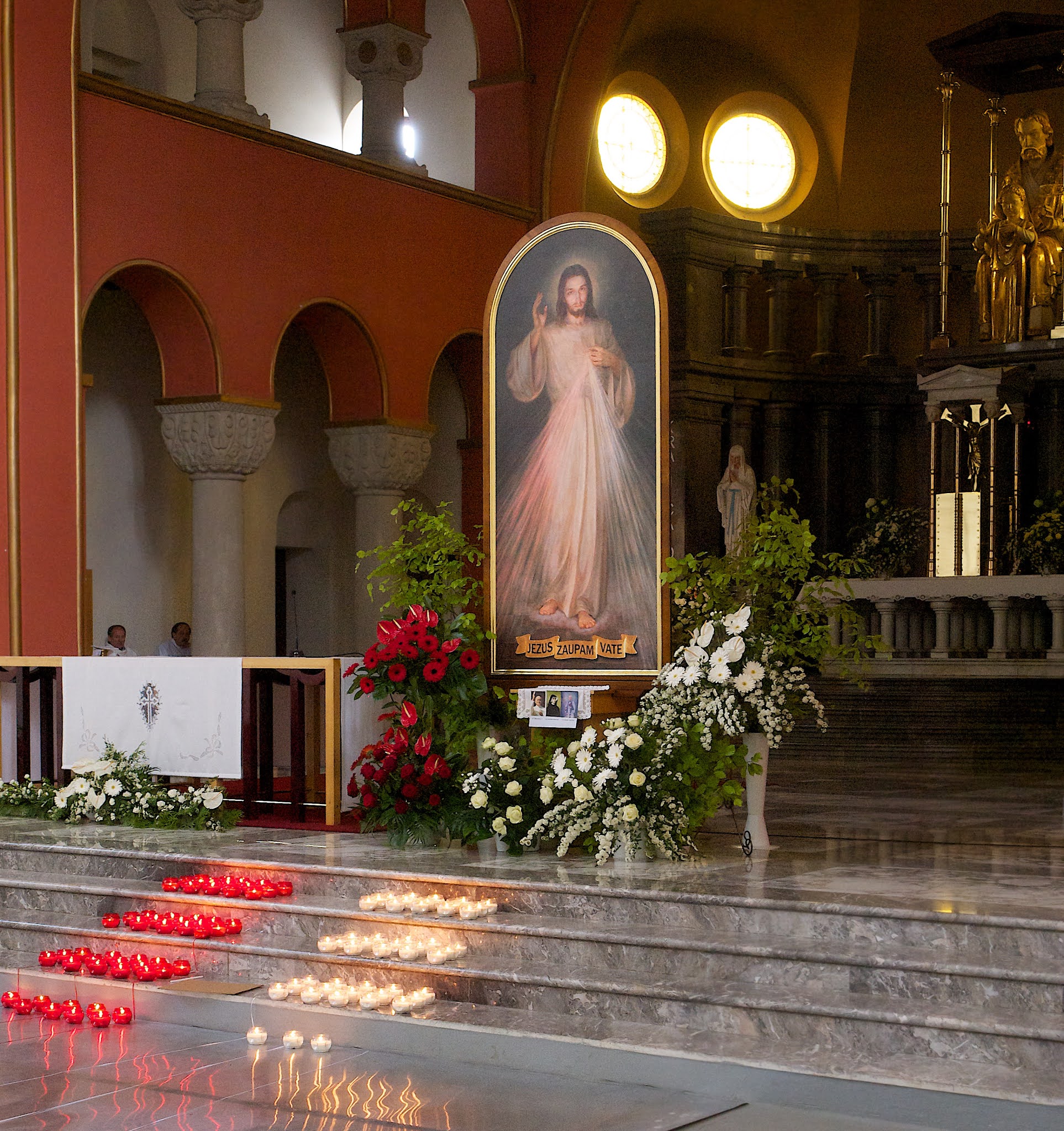
The familiar image of Divine Mercy depicts Jesus clothed in white with His right hand raised in blessing and His left touching his chest.  Rays of red and white emanate from beneath His hand.  The rays recall the blood and water that flowed from Jesus' side when he was pierced by the soldier's lance. They represent the Divine Mercy poured out upon the world through baptism and the Eucharist.  Below the image is the signature: "Jesus I trust in You." 


When considering today's gospel many like to slag Thomas, or Doubting Thomas as he is colloquially known.  But doing so misses a much deeper meaning. The narrative of Thomas is not about doubt. It is about faith, faith that, like ours, was tested.   Thomas's faith emerged victorious from that test.  Faith is not the opposite of doubt.  Faith's opposite is indifference.  Faith and doubt are sides of the same coin. One cannot exist without the other.  Faith must always contend with periods of doubt throughout life. Faith does not mature or come to fullness without periodic struggles with doubt, struggles during which we wonder about deeper meaning.


The faith of many has been tested throughout this ghastly year during which covid forced many to be away from the Mass. It was a year of bureaucratic cruelty during which absurd, unthinking,  merciless, and morally wrong regulations in hospitals and care homes forced many to die alone and terrified, without the comforting presence  of a family member or friend at the bedside. The sad reality is that computer images via zoom and cell phones don't cut it when one is dying, especially during the frequently associated delirium that precedes it.


The papers screeched:  ALL HEALTH CARE WORKERS ARE HEROES. That is an arguable proposition at best.  Despite being staffed and administered by so called heroes,  hospitals and homes denied a husband, or wife, or child, attired similarly to your average nursing assistant, the opportunity to attend to a dying loved one, to offer a sip of water every few minutes,  to be present when the patient woke, and to perhaps ease the delirium. 


Institutions chose a cruel one-size-fits-all approach created by faceless and merciless bureaucrats who made sure they took care of their own first.  Pennsylvania's former secretary of health moved his (sic) mother out of her assisted living into a hotel before issuing an edict that all facilities had to accept covid transfers from hospitals.  


One weeps for those who will never recover from their guilt over being forced to abandon a dying parent, husband, wife, or child because of government and administrative fiat.  Many were, and still are, forced to die without the benefit of the sacraments because in Massachusetts, priests who serve nursing homes are considered vendors, classed with beauticians and barbers, and thus barred from anointing the dying, hearing their confessions, and absolving them of their sins during their last hours.  This is the antithesis of mercy and approaches the immoral.


Our trust in those elected to govern has been tested.  It may have been completely destroyed.  A weeping physician proclaiming pending doom on national TV is not an image in which one can have confidence. 


What of faith in God? 


Thomas, who was not present when Jesus first appeared after his Resurrection,  can be a model for us today.  Thomas' love for Jesus did not die on the cross, just as ours should not die because of government fiat. Thomas continued to love Jesus with the same kind of love we hold for a dead parent or friend, a love that may keep us off-balance for a long time. In his sorrow he found it difficult  to believe the message of the other apostles that they had seen Him.  His faith was tested.  And then we hear his faith-filled gasp when Jesus appeared:  “My Lord and my God!”


In his Letter to the Romans Paul reminds us that,  “Faith comes from what is heard and what is heard comes by the preaching of Jesus Christ.”  That preaching of Jesus Christ does not come to us exclusively in oral form as it did at the Sermon on the Mount or in Jesus' many parables to His disciples.  Jesus' preaching comes to us in scripture, in the tradition of the Church, and, most especially, in the reception of the Eucharist.  Over the coming weeks we will hear of the beginnings of the Church.  Those early communities had the task of defining what it means to be a follower of Jesus Christ. 


In today's reading from Acts we hear of communal mercy that fulfilled the needs of those who otherwise would have gone without. That mercy is a reflection of the Divine Mercy bestowed on us today.  We will hear more in the coming weeks. 


At the end of their encounter, Jesus asked Thomas a question and bestowed a blessing, “Have you believed because you have seen me?  Blessed are those who have not seen and yet believe.”  We too must answer that question. 


The last sentence of this pericope puts the Gospels into perspective:  “Now, Jesus did many other signs in the presence of his disciples that are not written in this book.  But these are written that you may come to believe that Jesus is the Christ, the Son of God, and that through this belief you may have life in His name.” 


The gospels are not albums of verbal snapshots from Jesus' life.  They are not log books tracing Jesus' daily movements. There is no Captain Kirk-like "Star Date."  The gospels are not diaries of Jesus’ day-to-day thoughts and movements. They  are not history in the modern understanding of the word.   We can never interpret the gospels solely through the lenses of journalism, anthropology, or science without frustration and the risk of faithlessness.  


The Gospels proclaims one essential truth, that Jesus of Nazareth, of whom it speaks, is the Lord.  Thus, the fullness of Easter joy is contained in Thomas’ faith-filled, startled, and ultimately joyous proclamation.  That is why we too can gaze upon the True Body and Blood of Christ, from which flows the Divine Mercy, and say with Thomas and all the Church, “My Lord and My God.”  


Confitemini Domino quoniam bonus,

quoniam in saeculum misericordia eius


Alleluia, Alleluia, Alleluia

______________________________________________________


The photos below are from Divine Mercy Sunday 2017 when I was living with the Jesuit community in Ljubljana.  The church was full.  The men asked if I could take some shots.  In the end I walked over 2.5 miles during the two plus hour liturgy.


 + Fr. Jack, SJ, MD


Sunday, April 4, 2021

Easter

 Acts 10:34a, 37-43

Ps 118: 1-2, 16-17, 22-23

Col 3:1-4

Jn 20:1-9


“This is the day the Lord has made; 

let us rejoice and be glad.” 


These joyful words have been circling the globe for hours. First in Australia, then Taiwan and the Churches of Mainland China.  After passing through Asia and Russia they were proclaimed in Poland, Slovenia and England while the East Coast of the United States was barely waking up. An then they swept across North and South America in churches, monasteries, and convents as the celebration completed its global orbit.  


The words from the psalm were repeated in: Mandarin, Fujianese, Swahili, Tagalog, Slovenian, Croatian, Portuguese, French, English, and every other tongue in the known world, as the news of Jesus’ resurrection from the dead is proclaimed yet again. 


The first reading from the Acts of the Apostles summarized Jesus’ life from His baptism to His death on the cross.  We heard the commission to the apostles to preach the message of salvation.  It is the same commission we received: Preach the message of salvation through Jesus!  Proclaim the Gospel of the Lord. 


That message is the reason we are to rejoice and be glad.  Jesus is the one set apart, a root meaning of the word holy. Those who believe in him have  forgiveness of sins through His name. 


As St. Paul so memorably wrote to the Romans:  “God showed his love for us in that while we were yet sinners Christ died for us.”  While we were yet sinners Christ died for us.  Jesus, fully Divine and fully human, Son of God and Son of Mary, like us in all things but sin, died for our sins, because of our sins, and to save us from those sins.  We are sinners.  But, we are sinners passionately loved by God.  We are redeemed by Jesus’ passion and death in a redemption made manifest in His resurrection from the dead.  What more can we say than “This is the day the Lord has made; 

let us rejoice and be glad.” 


In the proclamation of John’s Gospel we heard of the disciple’s astonishment, confusion, sorrow, and fear upon discovering that the tomb, in which Jesus had been placed, was empty. The burial cloths were rolled up and lying off to the side.  The last line of this Gospel reading is instructive:  “Remember, as yet they did not understand the Scripture that Jesus had to rise from the dead.”  They did not yet understand.  Despite the years that they had followed Him the disciples did not really understand who this Jesus was.  But that was going to change at Pentecost when the Holy Spirit descended.


The apostle’s confusion and lack of understanding of Jesus mirrors our situation.  Despite Jesus’ action in our lives, we don’t always understand.  Unlike the apostles who lived the events told here in real time we have scripture and the tradition of the Church to instruct us and help us understand.  Still, we don’t always get it.  We sometimes fail to understand how great a gift Jesus is to us. We sometimes fail to appreciate the gift he gave us.  We sometimes reject that gift outright. Thus, it is today, and every day, we are called to pray, to meditate on scripture and to receive the Sacred Body and Blood of Christ so that unlike the apostles, we will understand, we will see, and, through understanding and seeing,  we will believe. 


The words repeated while inscribing the paschal candle  are a very short catechism.  


“Christ yesterday and today

the beginning and the end. 

Alpha and Omega; 

all time belongs to him, 

and all the ages; 

to him be glory and power, 

through every age for ever.” 


“This is the day the Lord has made, 

let us rejoice and be glad.” 


Alleluia

Alleluia

Alleluia. 


______________________________________

An extraordinary night.  Over the past eight months I've been instructing a physician colleague to prepare him for baptism, confirmation, and communion in the Church.  It was quite a journey in which he pushed me.  I joked after Mass that he cost me at least $100 in books.  Four were baptized at St. Ignatius last night.  I had the joy of baptizing Tony.  Was going to post this homily last night but didn't have the energy to hold the computer let alone do anything with it.  


One of my favorite still-life shots taken in a tiny sacristy in a cloistered monastery.  I knew this was going to be black and white the moment the camera arrived in front of my eye.  


The small private chapel in which I celebrate Mass when visiting there.  I had just set up for Mass but had not yet started.  I will drive to the monastery in eight days to spend the week catching up with work. 

Have a most Blessed Easter.  


+ Fr. Jack, SJ, MD


Wednesday, March 24, 2021

May It Be Done Unto Me: Homily for the Solemnity of the Annunciation

Isaiah 7:10-14, 8:10

Psalm 40

Luke 1:25-38


Angelus Domini nuntiavit Mariæ,
Et concepit de Spiritu Sancto

"The Angel of the Lord declared unto Mary,
And she conceived of the Holy Spirit" 

With rare exceptions spaced many decades apart, the Solemnity of the Annunciation of the Lord  always falls during Lent.  This solemnity, this feast, is a welcome glimmer of hope during a season of penance and fasting.  We hear the prophecy in the first reading. We hear the fulfillment of that prophecy in Luke's Gospel.  We hear Ahaz's stubborn 'no' in the first reading.  We hear Mary's perfect 'yes' in the Gospel.  Isaiah narrates God's command to Ahaz that he ask for a sign.  Ahaz refused to ask.  In His frustration God told Ahaz the sign He would give. 


The Universe held its breath when the angel appeared in the house in Nazareth, a backwater town of no importance.  The angel was to carry news to a young woman living in the house.  How would she reply?  Is this the time or must the waiting continue?  The angel's appearance in the room startled the young woman.  The tension in the universe approached unbearable.  God had promised a sign, that the virgin should bear a son.  Is this the time?  Is this the woman?  The universe was still.  Nothing stirred.  All movement halted when it heard the angel's greeting, "Hail, full of grace!  The Lord is with you."


Clasping its hands in front of its heart, the universe waited for the scene to unfold. 


"Do not be afraid Mary,  for you have found favor with God. You will conceive and bear a son and you shall name him Jesus."  


The woman appeared puzzled and concerned, as if she were asking herself what the odd greeting meant. The universe was stilled.  Oddly, the anxious anticipation vanished to be replaced by a new calm.  The look on her face was changing.  Wait . . . . 


Maria dixit "Ecce ancilla Domini, 

fiat mihi secundum verbum tuum."


Mary said, "Behold, I am the handmaid of the Lord, 

May it be done unto me according to your word." 


The universe changed instantly.  It would never be the same.  A new calm descended. The prophecy would be fulfilled. The young woman's words penetrated the very substance of the universe where they would echo forever. The most yes in history had just been spoken.  And the universe rejoiced. The virgin had accepted her vocation to be the Theotokos, the God-bearer, in fulfillment of the prophecy to Ahaz.


Like us, Mary was endowed with free will.  She could have rejected the vocation the angel presented to her. It seems irreverent to suggest that Mary could have refused. Her decision, however, was not inevitable.  It was not forced by God.  She was chosen.  But she had her own choice and  she responded with yes.


Et Verbum caro factum est.

Et havitavit in nobis


And the Word was made flesh and dwelt among us.  


Angels rejoiced. Seraphim, Thrones, Powers, and Dominations celebrated. Mary's life would change. Joseph would soon receive her into his house. They would soon make the arduous journey to Bethlehem where Jesus would be born of the House of David, once again in fulfillment of a prophecy.


On this great feast the Eastern Church will sing a hymn to the Theotokos, a hymn to the God-bearer whose reply to the angel enabled the universe to rejoice: 


"Receive, O earth, the glad tidings of great joy.

Heavens, praise the glory of God. 

The Theotokos, the God-bearer, the living tabernacle of God

shall not be touched by an unclean hand. 

The lips of believers shall sing to her ceaselessly 

with the voice of angels crying joyfully, 

Hail full of grace, The Lord is with Thee."  

______________________________________________

A particularly favorite feast for many reasons.  Rather than putting up photos am including the YouTube of the men of the Dale Warland Singers performing Franz Beibl's Ave Maria that is a setting of the Angelus complete with verses and response

https://www.youtube.com/watch?v=pFPbNsGF0Y0


Thursday, March 18, 2021

How to be a man: Homily for the Solemnity of St Joseph

 Mt 1:16, 18-21, 24a


Matthew’s description of the events leading up to Jesus’ birth contains fewer details than Luke’s Gospel. It does not include  the splendid prayers from Luke--the Magnificat, the Benedictus and others--that have become part of the Church's liturgy.  But it is as important as Luke's exquisite narrative. Matthew’s Gospel is filled with human drama and marked by pathos, anxiety, and fear.  Most significantly, we hear about Joseph and come to understand why he was called a righteous man. We learn of his compassion when he planned to divorce Mary quietly, unwilling to subject her to shame, and possible stoning for being with child. We hear of his obedience when an angel appeared to him in a dream, "do not be afraid . . .  it is through the Holy Spirit that this child has been conceived.  She will bear a son and you are to name him Jesus, because he will save his people from their sins.”  


Not one word  is attributed to Joseph in scripture.  He remains silent throughout. We know that he was a good man, we know that he was a real man, who accepted the role of husband and father, doing that which was necessary.  But, we know this only through observing his actions rather than reading his words.  We know that he was righteous through his courage and obedience in doing what God commanded without complaint or protest. 


Mary’s fiat at the Annunciation--“May it be done unto me according to your word”--changed the history of the world and continues to change the history of the world.  The sound of her yes still echoes throughout the universe to this very moment.  It will echo for eternity and beyond eternity.  Joseph’s yes was silent.  His yes was as important as Mary's.  Joseph's yes also continues to echo throughout the universe, but it echoes in its example rather than the sound of its words.  Joseph was righteous because his obedience to God was immediate and without question.  


An angel would again come to him in a dream after Jesus' birth.  In his obedience, in his role as protector of his young family, Joseph would take them to Egypt for an extended exile that would last until Herod’s death. The 90-mile trip from Nazareth to Bethlehem with a pregnant wife could not have been easy.  The flight to Egypt was probably even more difficult and filled with greater anxiety and complicated by the almost overpowering fear of a father whose son's life is threatened. 


Pope Francis was inaugurated on 19 March, the Solemnity of St. Joseph, eight years ago.  He asked the following question in his homily:  "How does Joseph exercise his role as protector?"  The pope then answered the question in a way that explains why Joseph must be a model for all men, men who are fathers and grandfathers in particular, as well men who are responsible for the care of others.  


The Holy Father explained that Joseph exercised his role, "Discreetly, humbly and silently, but with an unfailing presence and utter fidelity, even when he finds it hard to understand." Joseph did what had to be done.  He did what had to be done without question and without complaint.  He did it with quiet strength that grew from his trust in God. That is why he is credited as righteous.  That is why we celebrate him with such solemnity today.


St. Joseph protector of families, pray for us. 


____________________________________________________


All but the first of the photos are of sv. Jože (St. Joseph) Church in Ljubljana, Slovenia.  Lived in the adjacent community during my time there.  


The sculpture of the Holy Family in Brezje, Slovenia.  The cross is actually several hundred yards away from the statue.  It is also much larger.  But if an observer kneels in front of the statue the cross appears in this way.   I could have gotten a bit better framing but it had rained, there was a puddle, and I was wearing wool slacks.  Black chinos I would have cared but wool?  Nah.


The bell tower from the road leading up to the castle. 


The bell tower at sunset one magnificent summer evening. 

 The interior of the church.  Commies had it for years.  A lot of work needs to be done. 


The statue of St. Joseph and the Child Jesus.  The altar was designed by Jože Plečnik I think in the 20s (last century not this).  Somehow it survived the community desecration of the church.  
+ Fr. Jack, SJ, MD

Saturday, March 13, 2021

May God Strike Me Dead: Homily for the 4th Sunday of Lent

2 Chr 36:14-16, 19-23

Ps 137 1-6

Eph 2:4-10

Jn 3:14-21


"Laetare Jerusalem: 

et conventum facite omnes 

qui diligitis eam."


"Rejoice, O Jerusalem; 

and gather round, 

all you who love her."


The Fourth Sunday of Lent is traditionally called Laetare Sunday. The name deriving from the first word of the entrance antiphon,  Laetare. Rejoice.


We mark Laetare Sunday visually by replacing the somber purple vestments with dusty rose. Note, dusty rose is NOT, it is absolutely not, hot pink. There is a difference.  The vestments for Laetare Sunday must not be the same as the color associated with Pepto-Bismol. The vestments visually remind us of a lightening of mood, transient though it may be, now that the penitential time is more than half over.   That change of color is an important signifier of what the late Jesuit Father Jim Schall described in one of his many essays. "Laetare Sunday is traditionally called a respite.  It makes us begin to feel the nearness of the Passion and the Resurrection, but with a reminder that even amid the Lenten fast and the coming remembrance of the Crucifixion, we are not to forget that Christianity is a religion of joy."  He goes to explain that, "Christianity is a religion of joy since it knows this world is not all there is; there is something precious beyond the world."  That precious something is apparent in today's readings and particularly in John's Gospel.


The Jewish Study Bible notes that "one of the hallmarks of the Book of Chronicles is its strict notion of divine providence and retribution . . . (through which) virtuous deeds lead to reward, (and) bad deeds bring punishment and suffering."  The book's uniqueness is its view of Divine compassion instead of retribution and punishment as the operative principle. It is God's Divine compassion that allows for repentance and forgiveness of sin. That compassion brings an eternal message of hope.   


No matter how often the Israelites violated the covenant forgiveness was available. God never forgot the covenant even when his people did so deliberately and repeatedly, even when they chose to worship false pagan gods. We are blessed because out of  God's mercy we receive forgiveness for our sins in the sacrament of confession, again and again, as often as we wish to partake of it.   


Psalm 137 is fascinating.  It reflects the notion of retribution for sin found in Chronicles. It illustrates the importance of holding to God, the importance of recalling and living within the covenant God made with His people. 

It is also one of the few instances in the psalter in which a physician can make an accurate diagnosis. 


"If I forget you O Jerusalem, 

may my right hand wither, 

may my tongue cleave 

to the roof of my mouth 

if I remember you not." 


For the sin of forgetting the covenant, the psalmist is calling down upon himself the Ancient Near Eastern version of the old schoolyard oath, "If I am lying may God strike me dead."  He is calling down a very specific punishment that many would find worse than being dead. 


Should he sin by forgetting what God had done for his people, the psalmist is asking that he be punished by having a stroke on the left side of his brain, the type of stroke that results in paralysis of the right hand and arm;  both of which eventually atrophy and wither and manifesting with the garbled speech of expressive aphasia that does, in fact, sound as if the tongue were stuck to the roof of the mouth. 


It is important to note that God is not threatening this punishment.  The psalmist is calling it down upon himself as punishment if he forgets.  Given the Ancient Near East understanding of disease he is saying that it would be better to be dead than to forget God and His covenant with the people. 


St. John Paul II of happy memory took words from Paul's Letter to the Ephesian for the title of his second encyclical Dives in Misericordia, Rich in Mercy, an encyclical in which he explored the mystery of redemption.  In section seven he wrote:  " . . . mercy is an indispensable dimension of love; it is . . . love's second name, and, at the same time, the specific manner in which love is revealed and effected . . ." 


We have been saved by grace and mercy.  John tells us as much in the gospel when he wrote, "For God so loved the world that he gave his only Son, so that everyone who believes in him might not perish but might have eternal life."  


This truth never loses its power to stun the believer into silence while leaving the non-believer perplexed by the scandal of the cross.  It is critical to recall when contemplating these words, that they do not even hint that we will not die. Rather, these words overthrow the power of death itself.  We all will die.  Ideally that moment will occur at the natural end of our lives rather than through so-called physician prescribed death, a euphemism for putting down the ill or demented elderly. We will all die but death itself has lost its power over us and will never regain it.  


"Laetare Jerusalem: 

et conventum facite omnes 

qui diligitis eam."

__________________________________________

Photos from a monastery


Sun-catcher in the cloister of a monastery


The Consecration at Mass


Sanctuary lamp in the monastic choir

Fr. Jack, SJ, MD


Sunday, March 7, 2021

Commandments and Zeal: Homily for the 3rd Sunday of Lent


Ex 20:1-17
Ps 19
I Cor 1:22-25
Jn 2:13-25
We adore Thee or Christ and we bless Thee
Because by Thy holy cross Thou hast redeemed the world.
What we know as the Ten Commandments or the Decalogue is not unique to Genesis in either the Hebrew or the Christian scripture. All of the laws and prohibitions appear elsewhere throughout scripture though not necessarily in identical form. But, they are unique in the history of the ancient world. They are unique because God was the author. This belief set the Jewish people apart from all others in the Ancient Near East. Elsewhere the laws were believed to be the product of human minds, particularly the king, perhaps with divine inspiration of some sort, but ultimately, law was a human conception. The laws, commands, or edicts of the Decalogue however, were given directly from God to Moses who relayed them to the people. Thus, obedience to the law--both the moral law and the civil law--became religious duties. This explains, in part, Jesus' response to His interlocutors who asked about paying the tax to the Empire: "Render unto Caesar that which is Caesar's and to God that which is God's." Thus, the laws against adultery or murder are as morally binding as the laws to observe the Sabbath and have no false gods are religiously binding.
The first three commandments define our duty toward God. The remaining commandments describe our duty toward family, community, and society in general. Killing. Adultery. Stealing. Lying about or bringing false witness against another, or coveting another's possessions all destabilize the community or devastate the family. Of all these sins none has a more devastating effect on the family than adultery. Adultery ruptures family bonds, destroys friendships, has the potential to cause economic insecurity and hardship, damages reputations, sometimes beyond repair, and, particularly if young children are involved, impairs their developing sense of trust in the world around them in ways that may not become conscious or apparent for many years.
The Gospel narrating Jesus' cleansing the Temple from profanation that violated the first three commandments, is an important reminder to, if not an antidote for, those who see Jesus as permissive of all things, sanctioning even immorality if it is enacted in the guise of love, and, at least according to the s
Speaker of the House of Representatives, having no problem with killing of infants in the womb.
This episode forces us to confront our ideas of how Jesus is and what He demands. It is not a warm and comforting scene. There is no gentle, hugging, or smiling Jesus here. This is not the Jesus of accommodation. There is no compromise or equivocation. For those for whom zeal and reverence for God’s house. or whose observance of the commandments is a sometimes thing that shifts with current social trends, the encounter with this Jesus is uncomfortable because it is a reminder that He is not a Jesus of accommodation to current social mores. He is not one to adapt to what people want, to what everyone is doing, or to water down the law as we are reminded in Matthew's gospel, "I have not come to abolish the law or the prophets, I have come not to abolish but to fulfill. . . . Amen, I say to you, until heaven and earth pass away, not the smallest letter or part of a letter will pass from the law, until all things have taken place." Thus, these frequent whines hold no water.
"Oh, c'mon Jesus everybody is selling animals in the Temple these days."
"Keep your religious belief out of my life."
"My body, Myself."
"I am the only one who can determine what is moral for me."
The Jesus of the gospels challenged political authorities. He challenged society at large in condemning adultery, divorce and extortion, among others. The Jesus of the gospels called a spade a spade. He did not cave in to secular society. He would not tolerate desecration of His Father’s house. We do well to remember that. The scene of Jesus overturning tables in the Temple and driving the money changers out with a whip bothers many. They are bothered because Jesus is not gentle, affirming, or negotiating. There is no way to manipulate his words or actions to be anything than what they are. The late Jesuit Father Stanley Marrow, made an insightful comment on this gospel passage in his commentary on this Gospel.
“One puzzling aspect of the narrative is how generation after generation can hear this account and persist in clinging to their cherished image of Jesus. . . so 'gentle and mild' as to be incapable of overthrowing anything, including the reader’s smugness. . . . The Jesus in this, or any other gospel, is not exactly a standard-bearer for bleeding hearts. The aim of the Gospel is not to provide us with the biography of an inspiring hero, who fits . . . our ambitions, conforms to our ideals, or meets our conceptions of what constitutes greatness.”
Fr. Marrow could have included that Jesus was not a standard bearer for political correctness, the politics of either the left or the right, or the au courant gender silliness. Without zeal for God’s house the Church cannot survive. Without the Eucharist, without the Real Presence of the Body and Blood of Christ, the Church does not exist. Everything else the Church does--peace, justice, health care, education-- is beside the point if it does not emerge from the Eucharist, from Christ's Real Presence among us.
Without zeal for God's house we might as well stay in bed on Sunday and watch the shopping channel, football , or 'The View.' Only zeal for God's house, only time spent in prayer and contemplation, will allow us to understand the basic truths we heard in the psalm.
"The decree of the Lord is trustworthy,
giving wisdom to the simple.
The precepts of the Lord are right,
rejoicing the heart,
the command of the Lord is clear,
enlightening the eye."
The Lord truly has the words to everlasting life.
If we are willing to hear them and listen to them.
We adore Thee or Christ and we bless Thee
Because by Thy holy cross Thou hast redeemed the world.
___________________________________________________________________
One of the great joys of photography is looking through photos randomly and allowing them to trigger memories of the place, the reason for the photo, and many associated feelings. These are three.

The Church of Saint James (sv. Jakob) in Ljubljana, Slovenia. The church was built between 1613-1615. It has been repaired, remodeled, and refreshed a few times over the centuries. It is a Jesuit church separate from sv. Jože (St. Joseph, built in the early 20th century) not too far away.

The books set up for vespers in a monastery.

Wandering through Ljubljana one very cold night. The candle and ashtray were on a table at an outdoor cafe. I took quite a few shots inadvertently because my hands were so cold I could not feel my fingers or tell when the shutter had been pressed.

+ Fr. Jack, SJ, MD